Turn your mortgage into a wealth-building tool. Smith Manoeuvre strategies, tax-smart planning, and honest math from two Canadian mortgage strategists.
Why Most Canadians Think the Education System Is Sabotaging Youth Careers
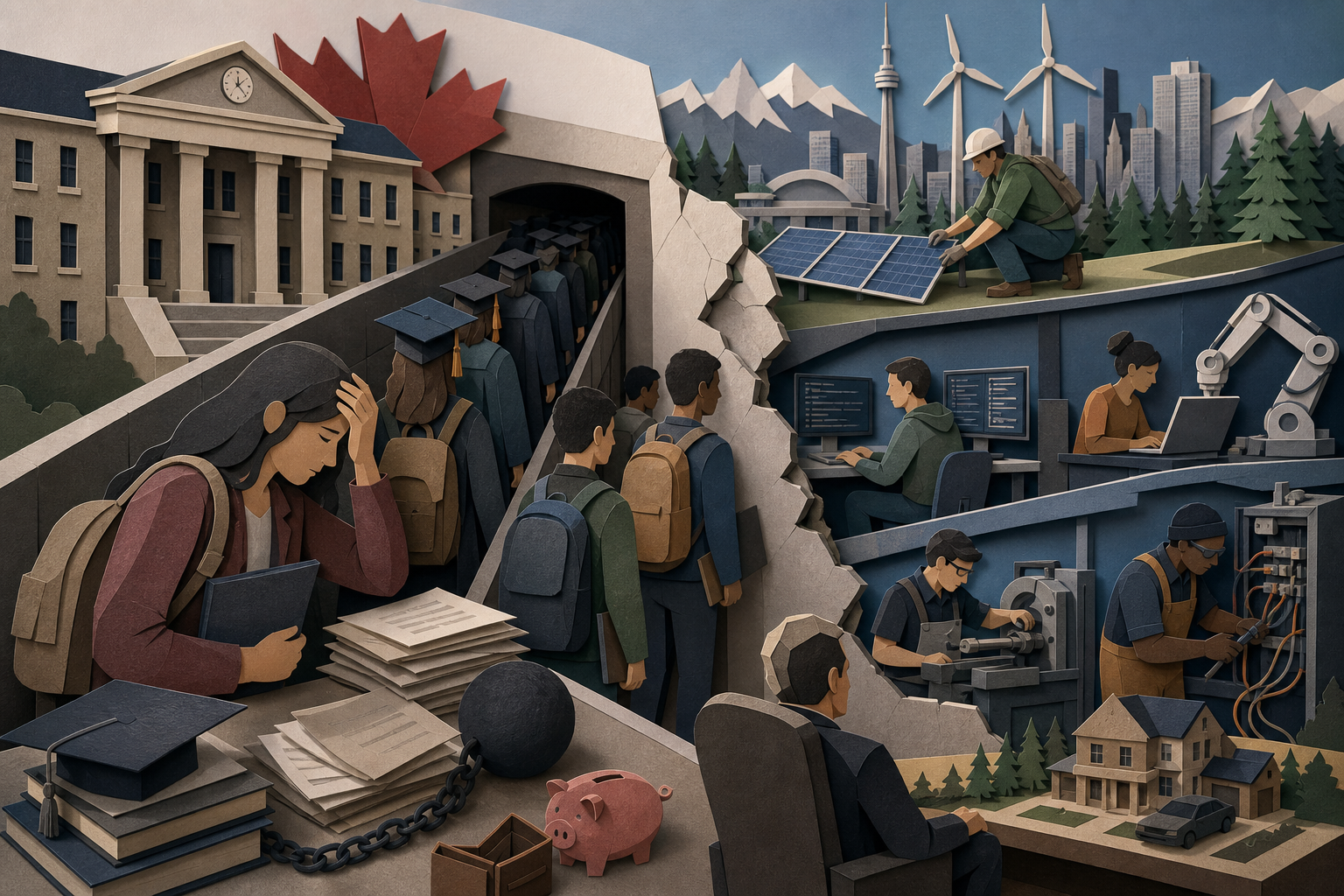
A 23-year-old with a Bachelor of Arts in sociology, $31,000 in student debt, and zero understanding of compound interest is the norm, not the exception. Ask her what a TFSA contribution limit is and you'll get a blank stare. Ask her employer what skills she's missing and you'll hear "critical thinking" before you hear "Excel."
The disconnect is structural. A strong majority of Canadians believe the K-12 and post-secondary system is out of sync with what the labor market actually requires. That's not a fringe complaint. That's a consensus that the pipeline is broken.
The credential doesn't guarantee the capability
Employers across high-growth sectors, AI, green energy, advanced manufacturing, report the same pattern: graduates show up with degrees but lack the practical fluency to execute entry-level work. A 2025 Business Council of Canada survey listed the top five in-demand roles as cybersecurity, healthcare support, skilled trades, data analysis, and renewable energy technicians. None of those fields can be adequately trained through a standard four-year liberal arts degree, yet most undergraduates still pursue exactly that path because it's what guidance counselors still frame as "safe."
The financial literacy gap is worse. Ontario announced a financial literacy graduation requirement in 2024 that begins implementation in the 2026-2027 school year, but implementation quality will vary by school board. A student in Thunder Bay may receive 40 hours of structured personal finance instruction. A student in Mississauga may get a single semester module taught by a gym teacher reading from a decade-old textbook. The result: young Canadians graduate unable to explain the difference between a GIC and a mutual fund, much less construct a debt repayment strategy or evaluate whether a 5.25% mortgage stress test rate makes homeownership viable on a $58,000 starting salary.
The average undergraduate now leaves school with approximately $29,000 in debt (Statistics Canada, 2024). That figure has climbed faster than inflation in seven of the last ten years. Tuition alone averages $7,734 for 2025/2026. Add rent in Toronto or Vancouver and the gap between "educated" and "financially secure" becomes a chasm most graduates spend a decade trying to cross.
The gig reality nobody's teaching toward
One in ten Canadian workers now participates in gig or platform work. That proportion is higher among workers under 30. Yet the education system still structures career prep around the assumption of linear, full-time employment with benefits, pensions, and predictable income. Nobody teaches 19-year-olds how to manage irregular cash flow, separate business and personal expenses, or build a tax reserve when there's no employer withholding at source. The curriculum was written for a labor market that no longer exists.
The pushback is always the same: it's not the school's job to teach taxes and investing. That's the parents' responsibility. Fine. Except the parents themselves were never taught, and the Financial Consumer Agency of Canada's own national strategy explicitly identifies schools as the primary channel for closing the literacy gap. Punting to families doesn't work when the knowledge base isn't there.
The STEM trap and the soft-skill void
The reflexive answer to all of this is "push more kids into STEM." Ontario did. British Columbia did. The federal government funded dozens of STEM scholarship programs. And yet Canadian business leaders consistently report that what graduates lack most isn't Python or calculus, it's adaptability, communication, and the ability to operate under ambiguity. Those are the durable skills. You can't automate them and you can't teach them in a semester elective.
The education system is designed to move slowly. Curriculum committees, provincial approval cycles, textbook rewrites, these processes take years. Generative AI arrived in the workplace faster than any committee could respond. The result is a permanent lag between what schools teach and what work requires.
Most provinces now recognize this. The question is whether modernization efforts can catch up before an entire generation graduates under-skilled, over-credentialed, and financially illiterate. A strong majority of Canadians remain skeptical that reform can move fast enough.



A 23-year-old with a Bachelor of Arts in sociology, $31,000 in student debt, and zero understanding of compound interest is the norm, not the exception. Ask her what a TFSA contribution limit is and you'll get a blank stare. Ask her employer what skills she's missing and you'll hear "critical thinking" before you hear "Excel."
The disconnect is structural. A strong majority of Canadians believe the K-12 and post-secondary system is out of sync with what the labor market actually requires. That's not a fringe complaint. That's a consensus that the pipeline is broken.
The credential doesn't guarantee the capability
Employers across high-growth sectors, AI, green energy, advanced manufacturing, report the same pattern: graduates show up with degrees but lack the practical fluency to execute entry-level work. A 2025 Business Council of Canada survey listed the top five in-demand roles as cybersecurity, healthcare support, skilled trades, data analysis, and renewable energy technicians. None of those fields can be adequately trained through a standard four-year liberal arts degree, yet most undergraduates still pursue exactly that path because it's what guidance counselors still frame as "safe."
The financial literacy gap is worse. Ontario announced a financial literacy graduation requirement in 2024 that begins implementation in the 2026-2027 school year, but implementation quality will vary by school board. A student in Thunder Bay may receive 40 hours of structured personal finance instruction. A student in Mississauga may get a single semester module taught by a gym teacher reading from a decade-old textbook. The result: young Canadians graduate unable to explain the difference between a GIC and a mutual fund, much less construct a debt repayment strategy or evaluate whether a 5.25% mortgage stress test rate makes homeownership viable on a $58,000 starting salary.
The average undergraduate now leaves school with approximately $29,000 in debt (Statistics Canada, 2024). That figure has climbed faster than inflation in seven of the last ten years. Tuition alone averages $7,734 for 2025/2026. Add rent in Toronto or Vancouver and the gap between "educated" and "financially secure" becomes a chasm most graduates spend a decade trying to cross.
The gig reality nobody's teaching toward
One in ten Canadian workers now participates in gig or platform work. That proportion is higher among workers under 30. Yet the education system still structures career prep around the assumption of linear, full-time employment with benefits, pensions, and predictable income. Nobody teaches 19-year-olds how to manage irregular cash flow, separate business and personal expenses, or build a tax reserve when there's no employer withholding at source. The curriculum was written for a labor market that no longer exists.
The pushback is always the same: it's not the school's job to teach taxes and investing. That's the parents' responsibility. Fine. Except the parents themselves were never taught, and the Financial Consumer Agency of Canada's own national strategy explicitly identifies schools as the primary channel for closing the literacy gap. Punting to families doesn't work when the knowledge base isn't there.
The STEM trap and the soft-skill void
The reflexive answer to all of this is "push more kids into STEM." Ontario did. British Columbia did. The federal government funded dozens of STEM scholarship programs. And yet Canadian business leaders consistently report that what graduates lack most isn't Python or calculus, it's adaptability, communication, and the ability to operate under ambiguity. Those are the durable skills. You can't automate them and you can't teach them in a semester elective.
The education system is designed to move slowly. Curriculum committees, provincial approval cycles, textbook rewrites, these processes take years. Generative AI arrived in the workplace faster than any committee could respond. The result is a permanent lag between what schools teach and what work requires.
Most provinces now recognize this. The question is whether modernization efforts can catch up before an entire generation graduates under-skilled, over-credentialed, and financially illiterate. A strong majority of Canadians remain skeptical that reform can move fast enough.
Sources
Read Next
Wells Fargo Says Rising Bond Yields Should Force You to Rethink Your Stock Portfolio
At the Top Tax Bracket, Every Dollar of Rental Interest Returns 53 Cents: Why the Smith Manoeuvre™ Is a High-Income Play
China's Treasury retreat to record lows rewrites the rules for bond investors
GIC Rates Below 4.2% Flip the Smith Manoeuvre™ Math From Marginal to Compelling