Turn your mortgage into a wealth-building tool. Smith Manoeuvre strategies, tax-smart planning, and honest math from two Canadian mortgage strategists.
What a Home EV Charging Station Actually Costs in Ontario in 2026
You can charge your Tesla from a regular wall outlet, but overnight you'll add maybe 40-64 kilometres of range from a Level 1 outlet. A Level 2 station on a 240V circuit gives you 240 to 400 kilometres of range overnight. That's the gap most Ontario buyers are paying to close in 2026, and the real cost isn't the charging box itself.
What the hardware costs
A quality Level 2 charging station runs between $700 and $1,300. ChargePoint, JuiceBox, and Flo are the names you'll see most often. The hardware price hasn't changed much since 2024. What has changed is that nearly all units sold now include smart features: scheduling through an app, usage tracking, and integration with your utility's overnight rate windows. If you're on an Ultra-Low Overnight (ULO) plan from Toronto Hydro or a similar program from another Ontario utility, the charger can start automatically at 11:00 PM when the rate drops.
If your driveway is exposed to Ontario winter without a garage, confirm the unit is NEMA 4 rated. The freeze-thaw cycle and heavy snow will destroy a charger not built for it. Most residential units are NEMA 4 or better, but the budget imports aren't always.
Installation costs more than the box
The licensed electrical contractor is the real line item. Standard installations, garage, panel within 10 meters, capacity available, run $800 to $2,000 in labour. That includes running 240V wiring, installing a dedicated 40- or 50-amp breaker, mounting the charger, and pulling the Electrical Safety Authority (ESA) permit. The permit is mandatory. The ESA inspection that follows is mandatory. Insurance companies have started asking for the certificate of inspection when a claim involves electrical work, and a charger installed without one voids coverage even if the fire started somewhere else.
Distance drives the price. If your panel is in the basement on the opposite side of the house from the garage, and the wire has to run through finished walls, you're closer to $3,000. If you're in a condo, add engineering reports and board approval under the Ontario Condominium Act's Right to Charge provisions, which can stretch the process by months.
The panel capacity problem
Most homes built in Ontario before 2000 have 100-amp service. A Level 2 charger pulls 40 to 50 amps. Your dryer pulls 30. Your air conditioner pulls 20 to 40 depending on the unit. Run all three at once and you're over capacity. The breaker trips, or worse, you're pulling more than the service can handle consistently and the wiring heats up.
Upgrading from 100-amp to 200-amp service costs $2,500 to $5,000 in 2026. That includes the new panel, the service line from the street if Hydro One or your local utility requires it, and the inspection. In parts of the GTA where the original service drop from the street pole to the house is aging copper or smaller gauge aluminum, some contractors are quoting $6,000 when that service drop itself needs replacement.
The alternative is a load management device. These are sometimes called DCCs (Demand Charge Controllers) or load shaders. They let your EV charger share a circuit with another high-draw appliance like the dryer, and they switch between them automatically. You never run both at the same time. Installation is $600 to $1,200, depending on configuration. For a household that doesn't regularly dry laundry and charge a car simultaneously, it's the cheaper path.
Wiring for two now
If you're installing one charger, running conduit and wire for a second station at the same time costs roughly $400 more in materials and half a day of labour. Total delta is typically $800 to $1,200. A second household vehicle is common in this income bracket, and even if the second car isn't electric now, it will be. The electrician is already there, the trench is already open, and the panel work is already done. Do it once.
Real estate appraisers in Ontario are starting to treat an installed Level 2 charger as a permanent fixture, similar to a high-end appliance. It supports resale value, particularly in areas where EV adoption is above 10%. The GTA, Ottawa, and Waterloo Region are all past that threshold.
Total all-in cost for most installations: $2,200 to $4,800. Panel upgrades push the high end to $7,500. That's the number.


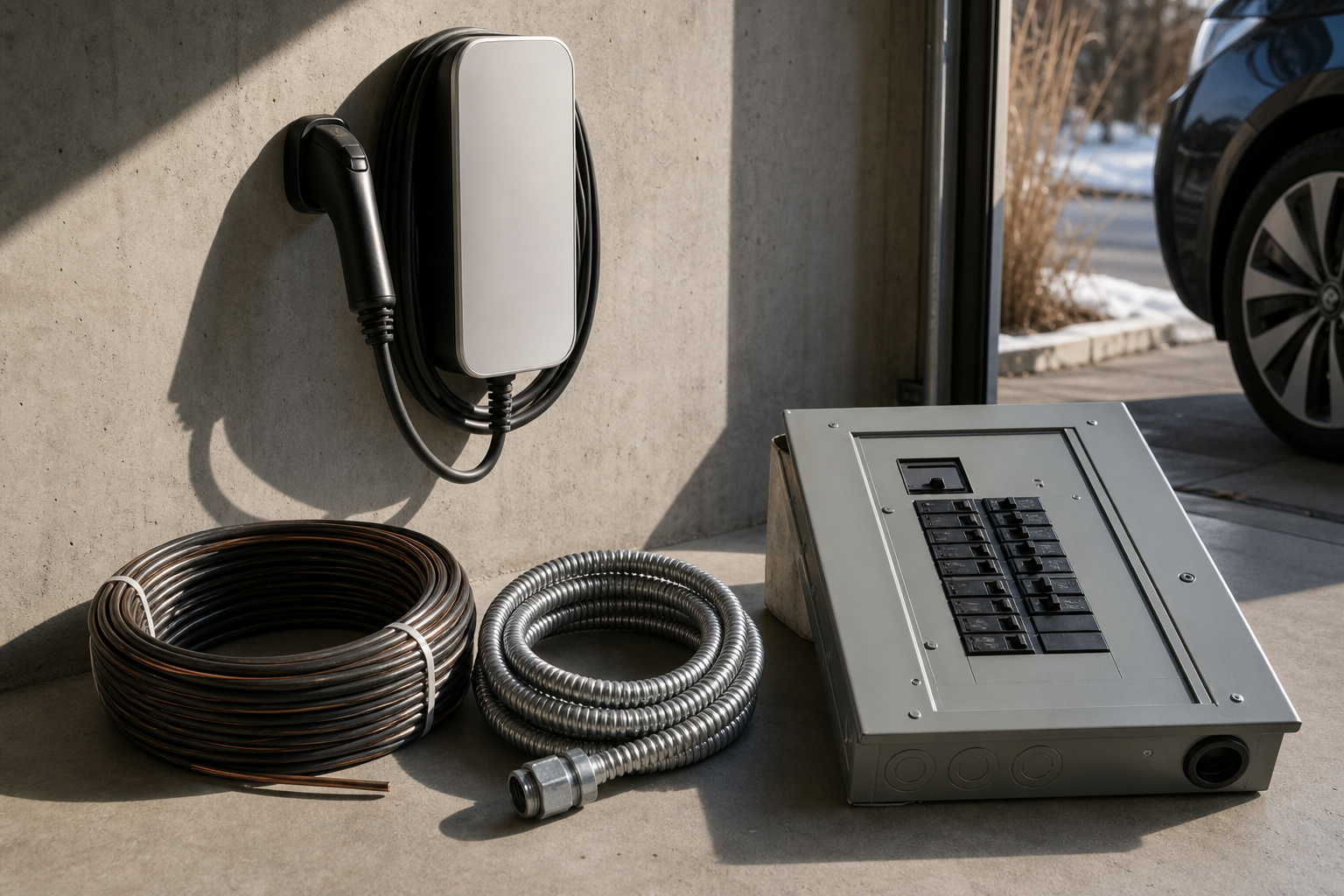

You can charge your Tesla from a regular wall outlet, but overnight you'll add maybe 40-64 kilometres of range from a Level 1 outlet. A Level 2 station on a 240V circuit gives you 240 to 400 kilometres of range overnight. That's the gap most Ontario buyers are paying to close in 2026, and the real cost isn't the charging box itself.
What the hardware costs
A quality Level 2 charging station runs between $700 and $1,300. ChargePoint, JuiceBox, and Flo are the names you'll see most often. The hardware price hasn't changed much since 2024. What has changed is that nearly all units sold now include smart features: scheduling through an app, usage tracking, and integration with your utility's overnight rate windows. If you're on an Ultra-Low Overnight (ULO) plan from Toronto Hydro or a similar program from another Ontario utility, the charger can start automatically at 11:00 PM when the rate drops.
If your driveway is exposed to Ontario winter without a garage, confirm the unit is NEMA 4 rated. The freeze-thaw cycle and heavy snow will destroy a charger not built for it. Most residential units are NEMA 4 or better, but the budget imports aren't always.
Installation costs more than the box
The licensed electrical contractor is the real line item. Standard installations, garage, panel within 10 meters, capacity available, run $800 to $2,000 in labour. That includes running 240V wiring, installing a dedicated 40- or 50-amp breaker, mounting the charger, and pulling the Electrical Safety Authority (ESA) permit. The permit is mandatory. The ESA inspection that follows is mandatory. Insurance companies have started asking for the certificate of inspection when a claim involves electrical work, and a charger installed without one voids coverage even if the fire started somewhere else.
Distance drives the price. If your panel is in the basement on the opposite side of the house from the garage, and the wire has to run through finished walls, you're closer to $3,000. If you're in a condo, add engineering reports and board approval under the Ontario Condominium Act's Right to Charge provisions, which can stretch the process by months.
The panel capacity problem
Most homes built in Ontario before 2000 have 100-amp service. A Level 2 charger pulls 40 to 50 amps. Your dryer pulls 30. Your air conditioner pulls 20 to 40 depending on the unit. Run all three at once and you're over capacity. The breaker trips, or worse, you're pulling more than the service can handle consistently and the wiring heats up.
Upgrading from 100-amp to 200-amp service costs $2,500 to $5,000 in 2026. That includes the new panel, the service line from the street if Hydro One or your local utility requires it, and the inspection. In parts of the GTA where the original service drop from the street pole to the house is aging copper or smaller gauge aluminum, some contractors are quoting $6,000 when that service drop itself needs replacement.
The alternative is a load management device. These are sometimes called DCCs (Demand Charge Controllers) or load shaders. They let your EV charger share a circuit with another high-draw appliance like the dryer, and they switch between them automatically. You never run both at the same time. Installation is $600 to $1,200, depending on configuration. For a household that doesn't regularly dry laundry and charge a car simultaneously, it's the cheaper path.
Wiring for two now
If you're installing one charger, running conduit and wire for a second station at the same time costs roughly $400 more in materials and half a day of labour. Total delta is typically $800 to $1,200. A second household vehicle is common in this income bracket, and even if the second car isn't electric now, it will be. The electrician is already there, the trench is already open, and the panel work is already done. Do it once.
Real estate appraisers in Ontario are starting to treat an installed Level 2 charger as a permanent fixture, similar to a high-end appliance. It supports resale value, particularly in areas where EV adoption is above 10%. The GTA, Ottawa, and Waterloo Region are all past that threshold.
Total all-in cost for most installations: $2,200 to $4,800. Panel upgrades push the high end to $7,500. That's the number.
Sources
Read Next
Wells Fargo Says Rising Bond Yields Should Force You to Rethink Your Stock Portfolio
At the Top Tax Bracket, Every Dollar of Rental Interest Returns 53 Cents: Why the Smith Manoeuvre™ Is a High-Income Play
China's Treasury retreat to record lows rewrites the rules for bond investors
GIC Rates Below 4.2% Flip the Smith Manoeuvre™ Math From Marginal to Compelling