Turn your mortgage into a wealth-building tool. Smith Manoeuvre strategies, tax-smart planning, and honest math from two Canadian mortgage strategists.
Trade wars don't end at the negotiating table. They end at the ballot box.
Canada and the U.S. exchange $3.6 billion in goods every single day. That flow didn't stop when tariffs hit 50% on certain Canadian imports in August 2026. It slowed. It got expensive. But it didn't reverse, because the supply chains that built those numbers don't dismantle in a quarter.
The media cycle treats each tariff announcement as a permanent rupture. Diplomatic language gets parsed for signals of resolution. Ministers meet. Press releases mention "productive dialogue." None of it matters as much as the calendar.
Inflation is the real mechanism
Trade wars end when the domestic political cost exceeds the domestic political gain. That cost shows up as inflation. Tariffs are a tax on consumers, and the U.S. economy runs on consumption. When the price of construction materials, auto parts, and food inputs starts climbing visibly, the backlash doesn't come from Ottawa. It comes from Michigan, Pennsylvania, and Wisconsin, states where 36 of the top export markets are in Canada, and whereComponents cross the border up to seven times before a finished vehicle rolls off the line.
The arithmetic is simple. A 50% tariff on Canadian steel raises the input cost for U.S. manufacturers relying on that steel. They either absorb the cost, which kills margin, or pass it through, which kills volume. Either way, someone's quarterly earnings call gets ugly, and someone's congressional district starts making phone calls.
Section 232 of the U.S. Trade Act lets the President impose tariffs on national security grounds. Section 301 covers "unfair trade practices." Both are executive actions, which means they bypass Congress on the way in. That also means they can be undone the same way, with an executive order, a carve-out, or a quiet exemption that gets published on a Friday afternoon and doesn't make the front page.
Canada's countermeasures are designed to accelerate that process. The C$29.8 billion retaliatory package announced in March 2025 wasn't random. It targeted specific products from specific districts, bourbon from Kentucky, motorcycles from Wisconsin, agriculture from the Midwest. Dollar-for-dollar retaliation, aimed at making the tariff politically expensive in places that matter during election cycles.
The CUSMA review is scheduled for 2026
The next formal review of the Canada-United States-Mexico Agreement is scheduled for 2026. That's a structural forcing function. Both sides know the agreement has a sunset clause, and both sides know that letting it lapse would cost more than any tariff ever collected.
The review creates a window for quiet rollbacks. Exemptions get issued. Timelines get extended. The tariff rate drops from 50% to 25%, then to 15%, then to zero with conditions nobody reads. The war doesn't end with a treaty signing. It ends with administrative fatigue and the realization that the revenue collected doesn't cover the political damage inflicted.
Roughly 68% of Canadian exports go to the U.S. That asymmetry looks like leverage until you map it the other way: the supply chain integration that makes those exports possible also makes them non-substitutable in the short run. You can't replace a supplier that's woven into your production process in six months. You can tax them. You can make it harder. But you can't cut the line without cutting your own output.
What this means for anyone with revenue south of the border
The instinct is to pull back, wait it out, diversify away. That makes sense if you think the war is permanent. It's the wrong move if you think it's cyclical.
Frame your business as part of the U.S. supply chain, not as a foreign competitor. Your clients need you to advocate with their own representatives. When a buyer in Ohio realizes that the tariff on your input is raising their cost of goods sold, they don't shrug. They call their senator.
The trade war will end. Not because anyone signed anything. Because someone in a swing state noticed the price of milk.


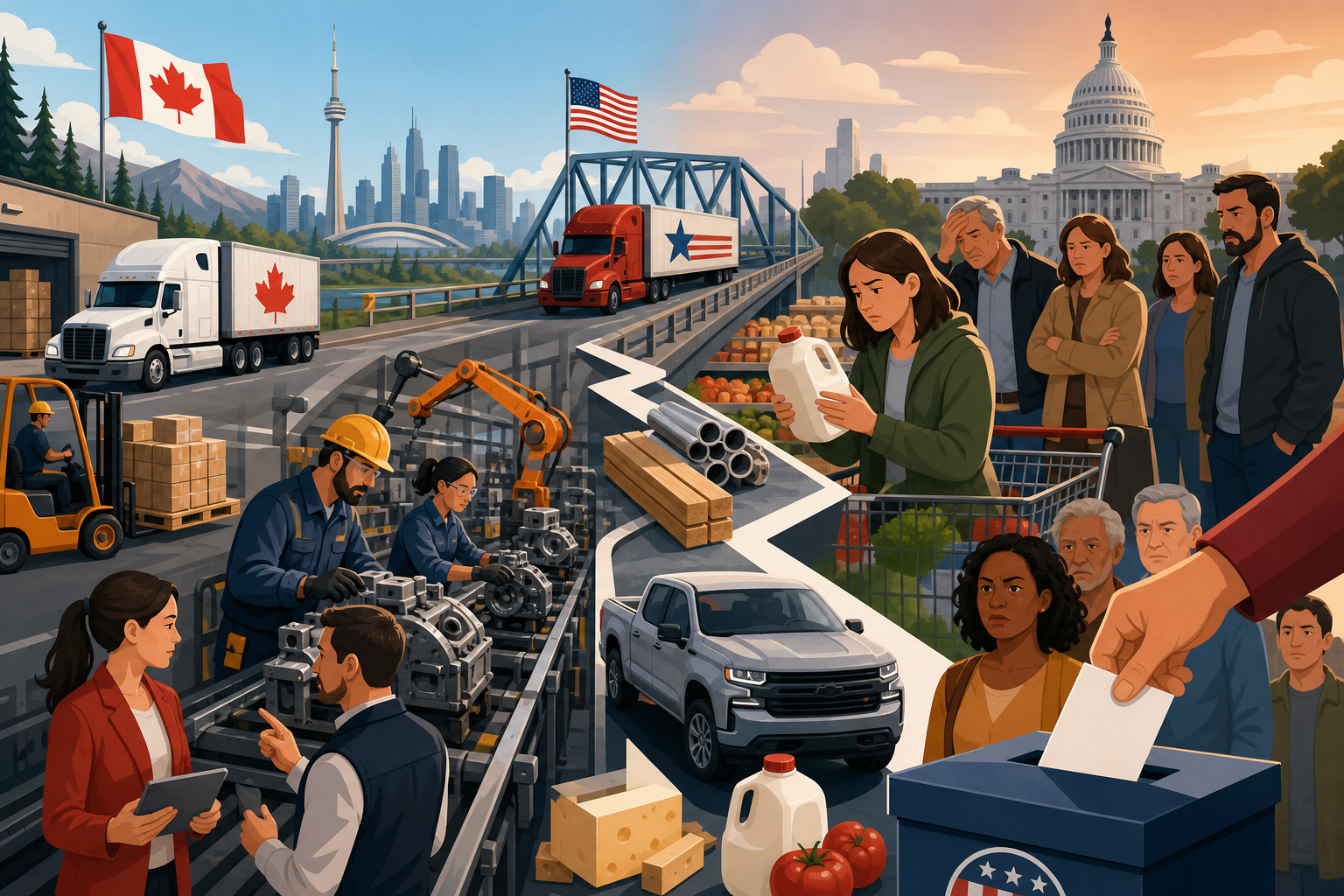

Canada and the U.S. exchange $3.6 billion in goods every single day. That flow didn't stop when tariffs hit 50% on certain Canadian imports in August 2026. It slowed. It got expensive. But it didn't reverse, because the supply chains that built those numbers don't dismantle in a quarter.
The media cycle treats each tariff announcement as a permanent rupture. Diplomatic language gets parsed for signals of resolution. Ministers meet. Press releases mention "productive dialogue." None of it matters as much as the calendar.
Inflation is the real mechanism
Trade wars end when the domestic political cost exceeds the domestic political gain. That cost shows up as inflation. Tariffs are a tax on consumers, and the U.S. economy runs on consumption. When the price of construction materials, auto parts, and food inputs starts climbing visibly, the backlash doesn't come from Ottawa. It comes from Michigan, Pennsylvania, and Wisconsin, states where 36 of the top export markets are in Canada, and whereComponents cross the border up to seven times before a finished vehicle rolls off the line.
The arithmetic is simple. A 50% tariff on Canadian steel raises the input cost for U.S. manufacturers relying on that steel. They either absorb the cost, which kills margin, or pass it through, which kills volume. Either way, someone's quarterly earnings call gets ugly, and someone's congressional district starts making phone calls.
Section 232 of the U.S. Trade Act lets the President impose tariffs on national security grounds. Section 301 covers "unfair trade practices." Both are executive actions, which means they bypass Congress on the way in. That also means they can be undone the same way, with an executive order, a carve-out, or a quiet exemption that gets published on a Friday afternoon and doesn't make the front page.
Canada's countermeasures are designed to accelerate that process. The C$29.8 billion retaliatory package announced in March 2025 wasn't random. It targeted specific products from specific districts, bourbon from Kentucky, motorcycles from Wisconsin, agriculture from the Midwest. Dollar-for-dollar retaliation, aimed at making the tariff politically expensive in places that matter during election cycles.
The CUSMA review is scheduled for 2026
The next formal review of the Canada-United States-Mexico Agreement is scheduled for 2026. That's a structural forcing function. Both sides know the agreement has a sunset clause, and both sides know that letting it lapse would cost more than any tariff ever collected.
The review creates a window for quiet rollbacks. Exemptions get issued. Timelines get extended. The tariff rate drops from 50% to 25%, then to 15%, then to zero with conditions nobody reads. The war doesn't end with a treaty signing. It ends with administrative fatigue and the realization that the revenue collected doesn't cover the political damage inflicted.
Roughly 68% of Canadian exports go to the U.S. That asymmetry looks like leverage until you map it the other way: the supply chain integration that makes those exports possible also makes them non-substitutable in the short run. You can't replace a supplier that's woven into your production process in six months. You can tax them. You can make it harder. But you can't cut the line without cutting your own output.
What this means for anyone with revenue south of the border
The instinct is to pull back, wait it out, diversify away. That makes sense if you think the war is permanent. It's the wrong move if you think it's cyclical.
Frame your business as part of the U.S. supply chain, not as a foreign competitor. Your clients need you to advocate with their own representatives. When a buyer in Ohio realizes that the tariff on your input is raising their cost of goods sold, they don't shrug. They call their senator.
The trade war will end. Not because anyone signed anything. Because someone in a swing state noticed the price of milk.
Sources
Read Next
Wells Fargo Says Rising Bond Yields Should Force You to Rethink Your Stock Portfolio
At the Top Tax Bracket, Every Dollar of Rental Interest Returns 53 Cents: Why the Smith Manoeuvre™ Is a High-Income Play
China's Treasury retreat to record lows rewrites the rules for bond investors
GIC Rates Below 4.2% Flip the Smith Manoeuvre™ Math From Marginal to Compelling