Turn your mortgage into a wealth-building tool. Smith Manoeuvre strategies, tax-smart planning, and honest math from two Canadian mortgage strategists.
Toronto's New Listings Fell in July, And Semi-Detached Homes Took the Hardest Hit
The average semi-detached home in the Greater Toronto Area sold for $964,922 in July 2026. That figure matters less because it crossed below the million-dollar threshold and more because of the gap that opened up between it and the year prior: 7.4%. Sales volume fell nearly 6% over the same window. The data, released by the Toronto Regional Real Estate Board, shows a market where the middle of the housing ladder is under the most pressure.
Townhouses recorded the second-sharpest drop in sales, down 2.7% year-over-year. But the real signal is not just what sold. It is what did not get listed.
The Listing Pullback
New listings contracted across the board in July. Sellers who might have brought properties to market in a typical summer pulled back instead. The dynamic is less a seasonal slowdown and more a structural hesitation: homeowners unwilling to accept the pricing environment that has settled in since the rate hikes of 2024 and 2025.
When listings fall faster than sales, the market tightens even as volume drops. This is not a flood of distressed properties. It is a standoff. Sellers hold because the numbers do not meet what they thought the home was worth six months ago. Buyers wait because they sense the market has not found its floor yet. The result is low liquidity.
Low liquidity does not mean stability. It means the market moves in unpredictable bursts. A single well-priced listing can draw fifteen offers. Another sits for forty-three days and sells under asking. Timing becomes harder to read when inventory is thin and sales are choppy.
Why Semi-Detached Homes Are Leading the Decline
Semi-detached homes occupy a specific spot in Toronto's housing ecosystem. They are the product families buy when they cannot afford a full detached but want more than a condo or a stacked townhouse. Priced just under a million dollars on average, they sit at the exact threshold where affordability collapses if rates or prices shift even slightly.
The 7.4% price drop suggests a category-specific correction. It could reflect genuine price compression. It could also reflect a shift in the mix of what sold: more properties at the lower end of the semi-detached range, more fixers, fewer move-in-ready homes in premium neighbourhoods. Either way, the category is no longer holding its value the way it did through the 2021-2022 surge.
Townhouses are faring better, relatively. The smaller sales decline likely reflects their position as the most affordable freehold option still standing. Buyers willing to move at all are gravitating toward the floor of the market, not the middle.
What a Tightening Market Actually Means
The word "tightening" can mislead. It sounds like competition is intensifying, like bidding wars are coming back. That is not the pattern here. Tightening in this context means supply is contracting while demand remains weak, creating a market that is harder to navigate but not hotter to buy into.
The Bank of Canada's rate path through 2024 and 2025 left borrowers cautious. Many locked in at higher rates and are not looking to move until the cost of carry makes more sense. The sellers who would have listed in a normal cycle are holding instead, either because they are not confident in the price they will get or because refinancing into a new mortgage at current rates wipes out any equity gain they were hoping to extract.
This creates a strange equilibrium. Prices are not collapsing because inventory is not flooding the market. But prices are not recovering either, because the buyers who would drive competition are either locked into existing homes or priced out entirely. The semi-detached segment, caught between affordability and aspiration, is where that tension shows up most clearly.


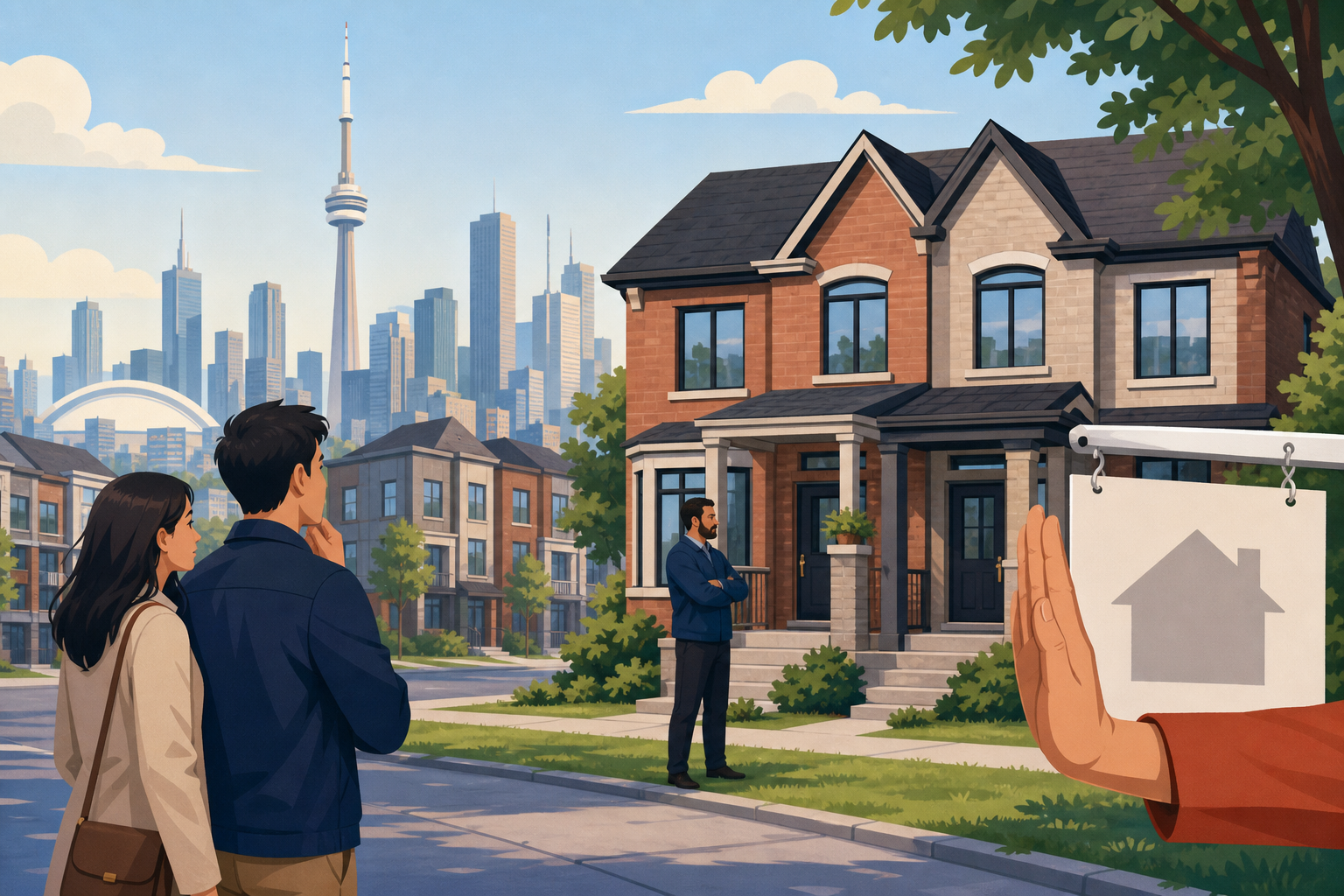

The average semi-detached home in the Greater Toronto Area sold for $964,922 in July 2026. That figure matters less because it crossed below the million-dollar threshold and more because of the gap that opened up between it and the year prior: 7.4%. Sales volume fell nearly 6% over the same window. The data, released by the Toronto Regional Real Estate Board, shows a market where the middle of the housing ladder is under the most pressure.
Townhouses recorded the second-sharpest drop in sales, down 2.7% year-over-year. But the real signal is not just what sold. It is what did not get listed.
The Listing Pullback
New listings contracted across the board in July. Sellers who might have brought properties to market in a typical summer pulled back instead. The dynamic is less a seasonal slowdown and more a structural hesitation: homeowners unwilling to accept the pricing environment that has settled in since the rate hikes of 2024 and 2025.
When listings fall faster than sales, the market tightens even as volume drops. This is not a flood of distressed properties. It is a standoff. Sellers hold because the numbers do not meet what they thought the home was worth six months ago. Buyers wait because they sense the market has not found its floor yet. The result is low liquidity.
Low liquidity does not mean stability. It means the market moves in unpredictable bursts. A single well-priced listing can draw fifteen offers. Another sits for forty-three days and sells under asking. Timing becomes harder to read when inventory is thin and sales are choppy.
Why Semi-Detached Homes Are Leading the Decline
Semi-detached homes occupy a specific spot in Toronto's housing ecosystem. They are the product families buy when they cannot afford a full detached but want more than a condo or a stacked townhouse. Priced just under a million dollars on average, they sit at the exact threshold where affordability collapses if rates or prices shift even slightly.
The 7.4% price drop suggests a category-specific correction. It could reflect genuine price compression. It could also reflect a shift in the mix of what sold: more properties at the lower end of the semi-detached range, more fixers, fewer move-in-ready homes in premium neighbourhoods. Either way, the category is no longer holding its value the way it did through the 2021-2022 surge.
Townhouses are faring better, relatively. The smaller sales decline likely reflects their position as the most affordable freehold option still standing. Buyers willing to move at all are gravitating toward the floor of the market, not the middle.
What a Tightening Market Actually Means
The word "tightening" can mislead. It sounds like competition is intensifying, like bidding wars are coming back. That is not the pattern here. Tightening in this context means supply is contracting while demand remains weak, creating a market that is harder to navigate but not hotter to buy into.
The Bank of Canada's rate path through 2024 and 2025 left borrowers cautious. Many locked in at higher rates and are not looking to move until the cost of carry makes more sense. The sellers who would have listed in a normal cycle are holding instead, either because they are not confident in the price they will get or because refinancing into a new mortgage at current rates wipes out any equity gain they were hoping to extract.
This creates a strange equilibrium. Prices are not collapsing because inventory is not flooding the market. But prices are not recovering either, because the buyers who would drive competition are either locked into existing homes or priced out entirely. The semi-detached segment, caught between affordability and aspiration, is where that tension shows up most clearly.
Read Next
Wells Fargo Says Rising Bond Yields Should Force You to Rethink Your Stock Portfolio
At the Top Tax Bracket, Every Dollar of Rental Interest Returns 53 Cents: Why the Smith Manoeuvre™ Is a High-Income Play
China's Treasury retreat to record lows rewrites the rules for bond investors
GIC Rates Below 4.2% Flip the Smith Manoeuvre™ Math From Marginal to Compelling