Turn your mortgage into a wealth-building tool. Smith Manoeuvre strategies, tax-smart planning, and honest math from two Canadian mortgage strategists.
The September Tariff Wave Will Hit Canadian Businesses Twice
A Canadian manufacturer pays customs officials to penalize their own supply chain. The payment is mandatory. The penalty hits immediately. And the entire sequence begins September 8.
Canada's $27.6 billion retaliatory tariff package is designed to pressure U.S. exporters by making their goods more expensive at the Canadian border. The theory is sound: target aluminum, steel, and consumer products flowing north, force pain onto specific congressional districts, extract concessions. But the mechanism has a structural flaw. The Canadian buyer, not the American seller, physically remits the tariff to the Canada Border Services Agency.
This creates the first hit. A furniture maker in Mississauga sourcing fasteners from Michigan now pays a 25% surtax on those components. A food processor in Calgary importing packaging materials from Wisconsin pays the added duty. The invoice arrives before the goods. The manufacturer writes the check. The cost shows up in their input ledger before the first unit rolls off the line.
Why Input Tariffs Compound Faster Than Export Duties
Tariffs on inputs are absorbed by whoever buys them. Export tariffs, by contrast, are typically built into the contract price and negotiated with the foreign customer. A Canadian steel exporter facing U.S. Section 232 duties can attempt to pass some of that cost downstream or renegotiate terms. A Canadian buyer facing a 50% surcharge on U.S. steel has no negotiation. The rate is set. The importer pays it. The only variables are how much inventory to pre-buy before September 8, and whether an alternative supplier exists.
For most small and medium-sized manufacturers, alternative suppliers do not exist at the required scale or lead time. Canada-U.S. supply chains are integrated down to the sub-component level. A single product may cross the border three times during assembly. Decoupling that in ninety days is not realistic. The September 8 deadline forces a binary choice: pay the tariff or halt production.
This is where the second hit lands. The same manufacturer now selling into a market shaped by the broader trade war faces both higher input costs and weakened demand. Customers across sectors are delaying capital purchases. Construction projects are on hold pending tariff clarity. Businesses that would normally restock inventory in Q3 are waiting. The revenue side contracts while the cost side inflates.
Economists estimate that retaliatory tariffs could add measurable pressure to Canada's Consumer Price Index, particularly in durable goods. A 10% input cost increase does not translate to a 10% price hike when the business also faces a 15% drop in order volume. It translates to margin compression, workforce reductions, or both.
The federal government collected $15.6 billion from earlier retaliatory measures as of March 2026, according to the Congressional Research Service. That revenue came from Canadian companies importing U.S. goods, not from U.S. exporters. The September package will generate additional billions. Every dollar represents a Canadian business paying its own government to make its supply chain more expensive.
Businesses can apply for remission orders if they can prove no alternative source exists for a specific component. The process is slow. Approvals are rare. Most firms will pay the tariff, absorb the cost where possible, and pass the remainder forward. Prices rise. Demand softens further.
Canada-U.S. goods trade runs $3.6 billion CAD daily. The September 8 tariffs will not stop that flow. They will tax it, on both ends, with Canadian importers funding their own government's retaliation while competing in a market where their U.S. rivals face symmetric pressures. The pain is reciprocal. The structure guarantees it hits twice.


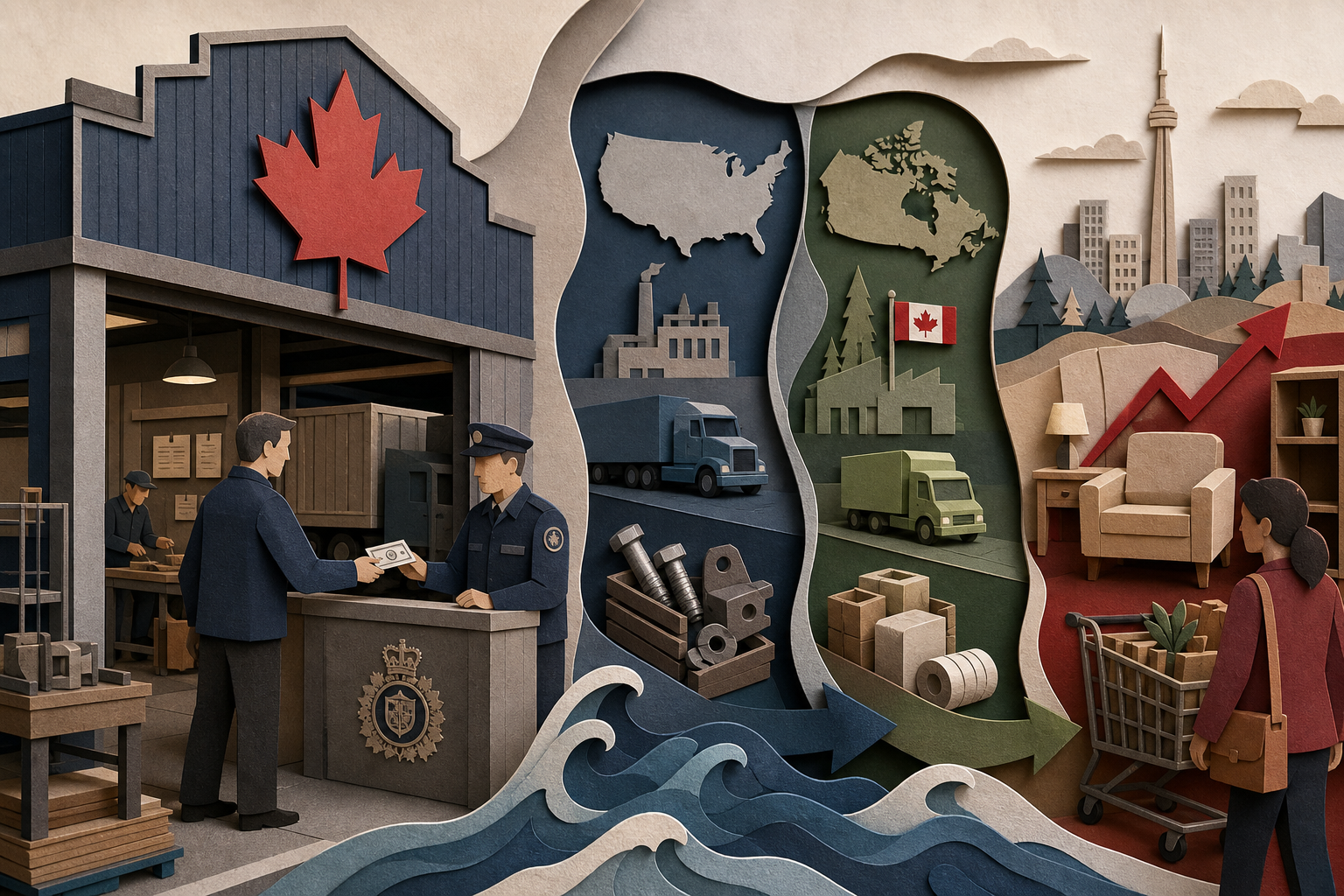

A Canadian manufacturer pays customs officials to penalize their own supply chain. The payment is mandatory. The penalty hits immediately. And the entire sequence begins September 8.
Canada's $27.6 billion retaliatory tariff package is designed to pressure U.S. exporters by making their goods more expensive at the Canadian border. The theory is sound: target aluminum, steel, and consumer products flowing north, force pain onto specific congressional districts, extract concessions. But the mechanism has a structural flaw. The Canadian buyer, not the American seller, physically remits the tariff to the Canada Border Services Agency.
This creates the first hit. A furniture maker in Mississauga sourcing fasteners from Michigan now pays a 25% surtax on those components. A food processor in Calgary importing packaging materials from Wisconsin pays the added duty. The invoice arrives before the goods. The manufacturer writes the check. The cost shows up in their input ledger before the first unit rolls off the line.
Why Input Tariffs Compound Faster Than Export Duties
Tariffs on inputs are absorbed by whoever buys them. Export tariffs, by contrast, are typically built into the contract price and negotiated with the foreign customer. A Canadian steel exporter facing U.S. Section 232 duties can attempt to pass some of that cost downstream or renegotiate terms. A Canadian buyer facing a 50% surcharge on U.S. steel has no negotiation. The rate is set. The importer pays it. The only variables are how much inventory to pre-buy before September 8, and whether an alternative supplier exists.
For most small and medium-sized manufacturers, alternative suppliers do not exist at the required scale or lead time. Canada-U.S. supply chains are integrated down to the sub-component level. A single product may cross the border three times during assembly. Decoupling that in ninety days is not realistic. The September 8 deadline forces a binary choice: pay the tariff or halt production.
This is where the second hit lands. The same manufacturer now selling into a market shaped by the broader trade war faces both higher input costs and weakened demand. Customers across sectors are delaying capital purchases. Construction projects are on hold pending tariff clarity. Businesses that would normally restock inventory in Q3 are waiting. The revenue side contracts while the cost side inflates.
Economists estimate that retaliatory tariffs could add measurable pressure to Canada's Consumer Price Index, particularly in durable goods. A 10% input cost increase does not translate to a 10% price hike when the business also faces a 15% drop in order volume. It translates to margin compression, workforce reductions, or both.
The federal government collected $15.6 billion from earlier retaliatory measures as of March 2026, according to the Congressional Research Service. That revenue came from Canadian companies importing U.S. goods, not from U.S. exporters. The September package will generate additional billions. Every dollar represents a Canadian business paying its own government to make its supply chain more expensive.
Businesses can apply for remission orders if they can prove no alternative source exists for a specific component. The process is slow. Approvals are rare. Most firms will pay the tariff, absorb the cost where possible, and pass the remainder forward. Prices rise. Demand softens further.
Canada-U.S. goods trade runs $3.6 billion CAD daily. The September 8 tariffs will not stop that flow. They will tax it, on both ends, with Canadian importers funding their own government's retaliation while competing in a market where their U.S. rivals face symmetric pressures. The pain is reciprocal. The structure guarantees it hits twice.
Sources
Read Next
Wells Fargo Says Rising Bond Yields Should Force You to Rethink Your Stock Portfolio
At the Top Tax Bracket, Every Dollar of Rental Interest Returns 53 Cents: Why the Smith Manoeuvre™ Is a High-Income Play
China's Treasury retreat to record lows rewrites the rules for bond investors
GIC Rates Below 4.2% Flip the Smith Manoeuvre™ Math From Marginal to Compelling