Turn your mortgage into a wealth-building tool. Smith Manoeuvre strategies, tax-smart planning, and honest math from two Canadian mortgage strategists.
Ontario's Housing Target Faces a Power Grid Crisis: How 1.5 Million Homes Collides with Infrastructure Limits
The Independent Electricity System Operator told developers in Southwestern Ontario that new housing projects would face multi-year delays for grid connections, this was in late 2023, when Ontario's housing target, set in 2022, was 1.5 million homes over the next 10 years. The grid was already strained at that number. By January 2024, the federal government raised the national housing target to 3.87 million new homes over the next decade, a figure that Ontario would shoulder a substantial portion of. The bottleneck that existed under Ontario's original housing target did not disappear with the new federal ambitions. It got worse, and the delay hasn't been addressed at the pace the new math requires.
What Changed Between the Two Targets
The 151,000 figure represented Ontario's annual provincial housing target through 2031, set in 2022 under the More Homes Built Faster Act. That law streamlined municipal approvals and reduced development charges in some cases, all designed to remove friction at the zoning and permitting stage. The legislation did not include upgrades to the electrical lines, transformers, and substations needed to serve those homes.
In April 2024, the federal government announced Canada's Housing Plan, which raised the national target to 3.87 million new homes by 2031. Ontario's share of that target, based on population and existing shortfall, would be roughly 1.5 million homes over ten years (by 2031), set in 2022, more than 214,000 homes per year, compared to the earlier 151,000. The gap between what the grid could handle in 2023 and what the new target requires in 2026 is now measured in gigawatts of capacity that do not exist.
The Grid Problem Compounds at Scale
Electrical capacity for housing is not a per-unit calculation. A single-family home draws roughly 200 amperes at peak. A condo tower with 300 units requires a transformer vault, upgraded feeder lines, and often a new substation if the local grid segment is near capacity. Developers in regions like Kitchener-Waterloo, Hamilton, and parts of the Greater Toronto Area were already being quoted 24 to 36 months for new service connections in 2023. That was before the target increased.
The issue is not generation. Ontario has enough generation capacity in aggregate. The problem is the local lines, transformers, and substations that move electricity from transmission lines to individual buildings. Upgrading those components requires physical construction: trenching, vaulting, transformer installation, and in many cases, coordination with municipal road work. A substation that serves 15,000 homes takes three to five years to plan, approve, and build. The new target requires dozens of them, and none were pre-approved in anticipation of the April 2024 announcement.
What This Means for Buyers and Builders in 2026
If you are looking at pre-construction condos or new subdivisions with occupancy dates in 2027 or 2028, the electrical connection timeline is now part of the delivery risk. Builders who secured grid capacity before mid-2023 are in a stronger position. Newer projects applying for service are competing for the same limited queue of transformer installations and feeder line upgrades available from the utility, and the wait has lengthened.
For builders, the math has shifted. Ontario's original 10-year housing target required substantial municipal and utility coordination. The later federal ambitions intensified that coordination challenge, but utility approval processes have not accelerated proportionally. Developers are now factoring electrical delays into financing costs, which either extend construction timelines or get passed through to buyers as higher prices.
For policymakers, the gap is structural. Hitting 1.5 million homes in Ontario by 2031 requires a matching investment in the transformer stations, feeder lines, and substations that serve them. Without that investment, either the target will not be met, or homes will be built without the electrical service to occupy them. Neither outcome solves the housing crisis.
The bottleneck that existed at 151,000 homes did not scale linearly when the target went to 3.87 million nationally. It scaled exponentially, because the transformers and feeder lines required to support density cannot be modular. Fixing it requires capital, time, and coordination that should have started before the new target was announced. Planning for the higher target did not begin in advance.


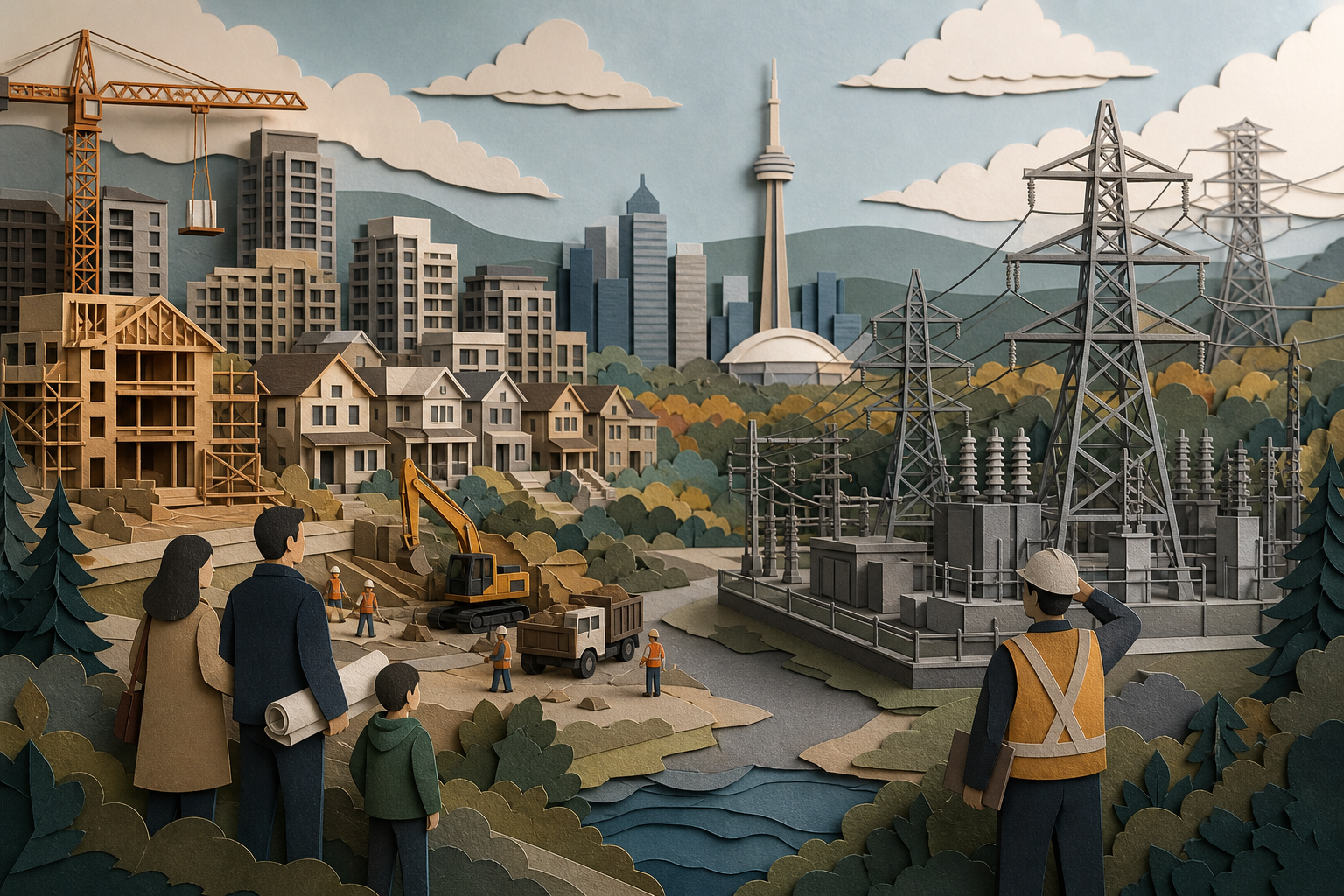

The Independent Electricity System Operator told developers in Southwestern Ontario that new housing projects would face multi-year delays for grid connections, this was in late 2023, when Ontario's housing target, set in 2022, was 1.5 million homes over the next 10 years. The grid was already strained at that number. By January 2024, the federal government raised the national housing target to 3.87 million new homes over the next decade, a figure that Ontario would shoulder a substantial portion of. The bottleneck that existed under Ontario's original housing target did not disappear with the new federal ambitions. It got worse, and the delay hasn't been addressed at the pace the new math requires.
What Changed Between the Two Targets
The 151,000 figure represented Ontario's annual provincial housing target through 2031, set in 2022 under the More Homes Built Faster Act. That law streamlined municipal approvals and reduced development charges in some cases, all designed to remove friction at the zoning and permitting stage. The legislation did not include upgrades to the electrical lines, transformers, and substations needed to serve those homes.
In April 2024, the federal government announced Canada's Housing Plan, which raised the national target to 3.87 million new homes by 2031. Ontario's share of that target, based on population and existing shortfall, would be roughly 1.5 million homes over ten years (by 2031), set in 2022, more than 214,000 homes per year, compared to the earlier 151,000. The gap between what the grid could handle in 2023 and what the new target requires in 2026 is now measured in gigawatts of capacity that do not exist.
The Grid Problem Compounds at Scale
Electrical capacity for housing is not a per-unit calculation. A single-family home draws roughly 200 amperes at peak. A condo tower with 300 units requires a transformer vault, upgraded feeder lines, and often a new substation if the local grid segment is near capacity. Developers in regions like Kitchener-Waterloo, Hamilton, and parts of the Greater Toronto Area were already being quoted 24 to 36 months for new service connections in 2023. That was before the target increased.
The issue is not generation. Ontario has enough generation capacity in aggregate. The problem is the local lines, transformers, and substations that move electricity from transmission lines to individual buildings. Upgrading those components requires physical construction: trenching, vaulting, transformer installation, and in many cases, coordination with municipal road work. A substation that serves 15,000 homes takes three to five years to plan, approve, and build. The new target requires dozens of them, and none were pre-approved in anticipation of the April 2024 announcement.
What This Means for Buyers and Builders in 2026
If you are looking at pre-construction condos or new subdivisions with occupancy dates in 2027 or 2028, the electrical connection timeline is now part of the delivery risk. Builders who secured grid capacity before mid-2023 are in a stronger position. Newer projects applying for service are competing for the same limited queue of transformer installations and feeder line upgrades available from the utility, and the wait has lengthened.
For builders, the math has shifted. Ontario's original 10-year housing target required substantial municipal and utility coordination. The later federal ambitions intensified that coordination challenge, but utility approval processes have not accelerated proportionally. Developers are now factoring electrical delays into financing costs, which either extend construction timelines or get passed through to buyers as higher prices.
For policymakers, the gap is structural. Hitting 1.5 million homes in Ontario by 2031 requires a matching investment in the transformer stations, feeder lines, and substations that serve them. Without that investment, either the target will not be met, or homes will be built without the electrical service to occupy them. Neither outcome solves the housing crisis.
The bottleneck that existed at 151,000 homes did not scale linearly when the target went to 3.87 million nationally. It scaled exponentially, because the transformers and feeder lines required to support density cannot be modular. Fixing it requires capital, time, and coordination that should have started before the new target was announced. Planning for the higher target did not begin in advance.
Sources
Read Next
Wells Fargo Says Rising Bond Yields Should Force You to Rethink Your Stock Portfolio
At the Top Tax Bracket, Every Dollar of Rental Interest Returns 53 Cents: Why the Smith Manoeuvre™ Is a High-Income Play
China's Treasury retreat to record lows rewrites the rules for bond investors
GIC Rates Below 4.2% Flip the Smith Manoeuvre™ Math From Marginal to Compelling