Turn your mortgage into a wealth-building tool. Smith Manoeuvre strategies, tax-smart planning, and honest math from two Canadian mortgage strategists.
One in Four Canadians Will Pay Only Credit Card Minimums in 2026. Here's What That Really Costs.
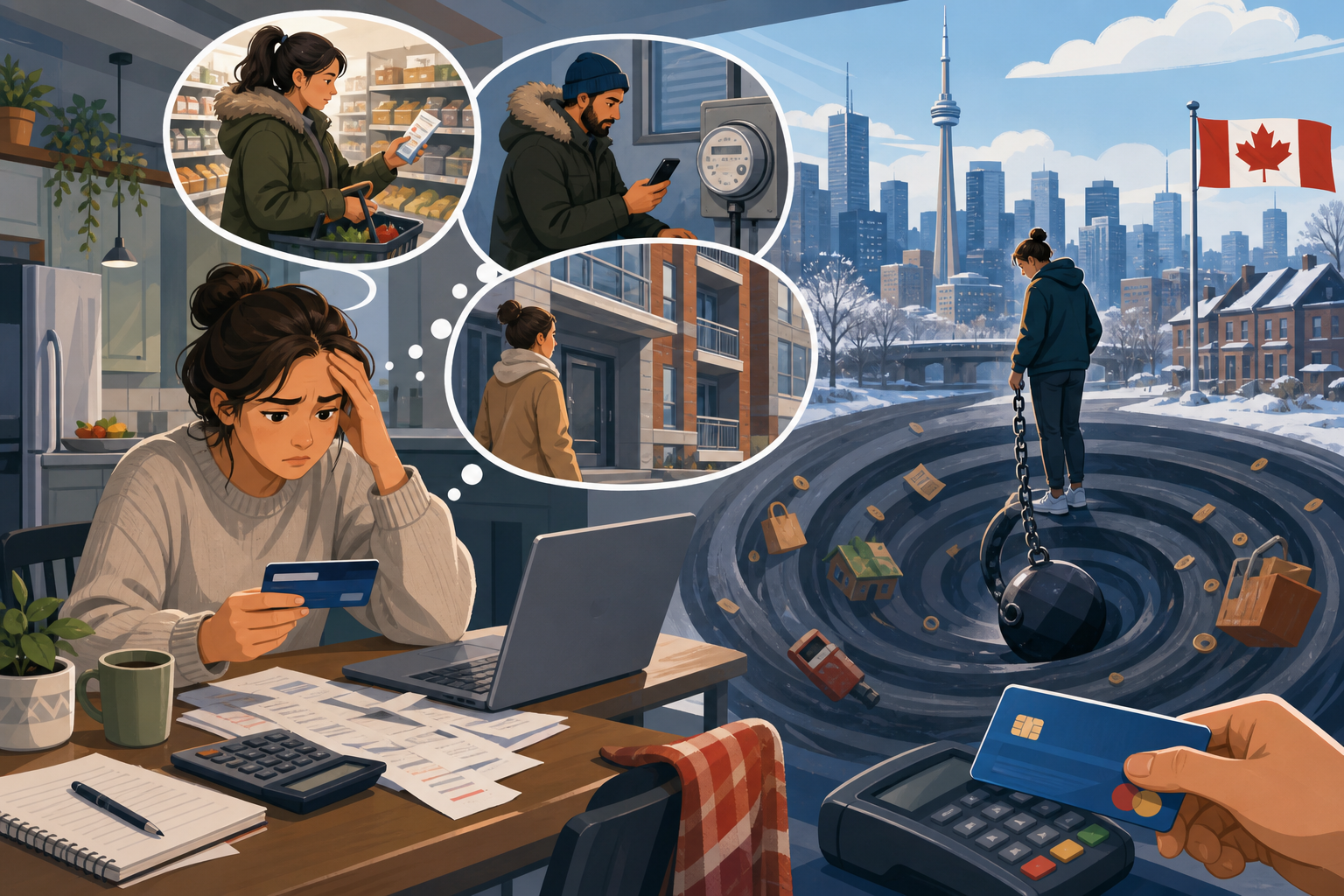
A $4,500 balance on a standard Canadian credit card at 20% interest takes 21 years to clear if you pay only the minimum. You'll hand the bank $6,100 in interest alone. That's not a hypothetical worst case, it's the math that now applies to one in four Canadians who say they'll make minimum payments only in 2026, according to Equifax Canada.
The shift isn't about lifestyle spending. It's about survival. The 25% who report they can't pay more than the minimum are increasingly using credit cards for groceries, utilities, and rent, essentials that used to be paid from cash flow. Total credit card balances in Canada hit around $4,200 per consumer on average in 2026,[2] up from roughly $3,909 to $4,119 in 2023. The spike tracks directly with the cumulative price resets from 2021 to 2024. Inflation may have stabilized near 2%, but the floor for household expenses didn't come back down.
The Compounding Trap Most Lenders Won't Explain
Minimum payments are structured to keep you profitable, not solvent. On a $4,500 balance at 19.99% APR, the minimum is typically 3% of the balance or $10, whichever is higher. In month one, that's $135. Sounds manageable. What they don't advertise: $75 of that goes to interest. You've reduced the principal by $60.
Month two, the minimum drops to $133. You're still paying mostly interest. The balance declines so slowly that by year three, you've paid $3,200 and still owe $3,800. Keep making minimums with no new charges and you'll pay $10,600 total over 21 years. Add even $200 a month in new charges, groceries, gas, hydro, and the timeline stretches to indefinite.
The Mortgage Renewal Multiplier
The 25% figure isn't evenly distributed. Canadians who renewed mortgages in 2025 or 2026 at rates 3-4 percentage points higher than their 2020-2021 contracts make up a disproportionate share. A $500,000 mortgage jumping from 2.5% to 5.5% adds roughly $800 a month in payments. For households already running tight budgets, that $800 gets bridged with revolving credit.
Lenders know this. They're tightening credit quality requirements for new personal loans, making it harder to consolidate card debt into fixed-rate products. The 90-day delinquency rate for non-mortgage loans rose 15-20% year-over-year across several provinces in the 2025-2026 period. Banks are pulling the ladder up just as people need it most.
What Breaks the Cycle
Three actions have the highest leverage if you're in the minimum-payment trap:
Call your issuer and ask for a rate reduction. If you've been a customer for more than two years with no missed payments, approximately 40% of cardholders who ask get some reduction, even 2-3 percentage points cuts years off the timeline. Script: "I've been a customer since [year]. My rate is [X]%. What options do I have to lower that?" They'll say no, then offer balance transfer checks or a temporary promotional rate. Take it.
Move the balance to a 0% promotional card while you still qualify. Tangerine, MBNA, and Scotiabank periodically run 10-12 month promotional periods. The transfer fee is typically 1-3%. On a $4,500 balance, that's $135 upfront to buy a year of zero interest. Every payment goes to principal. If you can pay $375/month, you clear it before the promo expires.
Redirect one recurring charge to debit, freeze the card, and automate $50 above minimum. The psychology of minimums is brutal: paying them feels like progress. It isn't. Automate even $50 more and the 21-year timeline drops to 8 years. Redirect your phone bill or streaming services to debit so the card balance stops growing.
The invisible recession isn't showing up in GDP. It's showing up in the 25% who can't pay more than the floor. Once you're treading water, compound interest does the rest.



A $4,500 balance on a standard Canadian credit card at 20% interest takes 21 years to clear if you pay only the minimum. You'll hand the bank $6,100 in interest alone. That's not a hypothetical worst case, it's the math that now applies to one in four Canadians who say they'll make minimum payments only in 2026, according to Equifax Canada.
The shift isn't about lifestyle spending. It's about survival. The 25% who report they can't pay more than the minimum are increasingly using credit cards for groceries, utilities, and rent, essentials that used to be paid from cash flow. Total credit card balances in Canada hit around $4,200 per consumer on average in 2026,[2] up from roughly $3,909 to $4,119 in 2023. The spike tracks directly with the cumulative price resets from 2021 to 2024. Inflation may have stabilized near 2%, but the floor for household expenses didn't come back down.
The Compounding Trap Most Lenders Won't Explain
Minimum payments are structured to keep you profitable, not solvent. On a $4,500 balance at 19.99% APR, the minimum is typically 3% of the balance or $10, whichever is higher. In month one, that's $135. Sounds manageable. What they don't advertise: $75 of that goes to interest. You've reduced the principal by $60.
Month two, the minimum drops to $133. You're still paying mostly interest. The balance declines so slowly that by year three, you've paid $3,200 and still owe $3,800. Keep making minimums with no new charges and you'll pay $10,600 total over 21 years. Add even $200 a month in new charges, groceries, gas, hydro, and the timeline stretches to indefinite.
The Mortgage Renewal Multiplier
The 25% figure isn't evenly distributed. Canadians who renewed mortgages in 2025 or 2026 at rates 3-4 percentage points higher than their 2020-2021 contracts make up a disproportionate share. A $500,000 mortgage jumping from 2.5% to 5.5% adds roughly $800 a month in payments. For households already running tight budgets, that $800 gets bridged with revolving credit.
Lenders know this. They're tightening credit quality requirements for new personal loans, making it harder to consolidate card debt into fixed-rate products. The 90-day delinquency rate for non-mortgage loans rose 15-20% year-over-year across several provinces in the 2025-2026 period. Banks are pulling the ladder up just as people need it most.
What Breaks the Cycle
Three actions have the highest leverage if you're in the minimum-payment trap:
Call your issuer and ask for a rate reduction. If you've been a customer for more than two years with no missed payments, approximately 40% of cardholders who ask get some reduction, even 2-3 percentage points cuts years off the timeline. Script: "I've been a customer since [year]. My rate is [X]%. What options do I have to lower that?" They'll say no, then offer balance transfer checks or a temporary promotional rate. Take it.
Move the balance to a 0% promotional card while you still qualify. Tangerine, MBNA, and Scotiabank periodically run 10-12 month promotional periods. The transfer fee is typically 1-3%. On a $4,500 balance, that's $135 upfront to buy a year of zero interest. Every payment goes to principal. If you can pay $375/month, you clear it before the promo expires.
Redirect one recurring charge to debit, freeze the card, and automate $50 above minimum. The psychology of minimums is brutal: paying them feels like progress. It isn't. Automate even $50 more and the 21-year timeline drops to 8 years. Redirect your phone bill or streaming services to debit so the card balance stops growing.
The invisible recession isn't showing up in GDP. It's showing up in the 25% who can't pay more than the floor. Once you're treading water, compound interest does the rest.
Sources
Read Next
Wells Fargo Says Rising Bond Yields Should Force You to Rethink Your Stock Portfolio
At the Top Tax Bracket, Every Dollar of Rental Interest Returns 53 Cents: Why the Smith Manoeuvre™ Is a High-Income Play
China's Treasury retreat to record lows rewrites the rules for bond investors
GIC Rates Below 4.2% Flip the Smith Manoeuvre™ Math From Marginal to Compelling