Turn your mortgage into a wealth-building tool. Smith Manoeuvre strategies, tax-smart planning, and honest math from two Canadian mortgage strategists.
How Canada Traded Wine Access for Steel Certainty in the Latest U.S. Deal
Prime Minister Mark Carney asked Canada's provincial premiers during a virtual briefing on Wednesday, August 19, 2026, to remove restrictions on American wine, beer, and spirits from provincial liquor boards. The request came as negotiators from both countries finalized language on a bilateral trade deal designed to prevent the Trump administration from imposing a 50% tariff on Canadian exports.
The trade-off is straightforward. Canada lifts provincial barriers that have frustrated U.S. alcohol producers for decades. In return, the United States backs away from Section 232 tariffs that would have hit $20 billion worth of Canadian steel, aluminum, and manufactured goods. The federal government in Ottawa cannot force provinces to change liquor policy, which is why Carney, acting as special envoy, went directly to the premiers with what amounts to a national economic ask disguised as a provincial regulatory tweak.
Why Alcohol Became the Lever
Interprovincial trade barriers in Canada, particularly around alcohol, have been a persistent irritant in North American trade frameworks since NAFTA. The U.S. Trade Representative has flagged discriminatory liquor board policies in formal reports going back to the mid-1990s. Provincial liquor monopolies control shelf placement, pricing, and distribution, often giving preferential treatment to local producers. A California winery or Oregon brewery has no direct route to market. They rely on provincial boards that frequently deprioritize foreign product.
When the Trump administration threatened universal baseline tariffs in early 2026, the alcohol file became useful leverage because it required no congressional approval and cost the federal government nothing. Lifting liquor restrictions is a concession Canada can deliver quickly if the provinces cooperate, which makes it an efficient bargaining chip in a negotiation where timing mattered more than scale.
What Canada Kept Off the Table
The agreement leaves supply management untouched. Dairy, poultry, and eggs remain protected by the quota system that has been a red line in every trade negotiation Canada has entered since the 1970s. Agriculture lobbies in the U.S. have pushed for quota elimination repeatedly. They did not get it here. The alcohol concession appears to have satisfied the reciprocity framing the Trump administration uses publicly without requiring Canada to dismantle the structural protections that underpin rural economies in Ontario, Quebec, and British Columbia.
Energy exports also stayed out of the deal, despite representing the largest single component of Canada-U.S. trade. In 2025, 73% of Canadian exports were destined for the United States, though that share has been declining in 2026, and energy, crude oil, natural gas, electricity, makes up the bulk of that flow. The tariff threat covered goods broadly, but exempting energy was understood by both sides as a baseline condition. Disrupting energy trade would have caused immediate price spikes in the U.S. Midwest and Northeast, a politically untenable outcome in an election cycle.
The Provincial Calculation
Premiers now face a choice between protecting local craft breweries and wineries from U.S. competition, or facilitating a federal deal that prevents auto plants, steel mills, and aerospace manufacturers from absorbing tariff costs that would ripple through the broader economy. The numbers are lopsided. Canada's retail alcohol market is worth $27.3 billion in 2026. Daily two-way trade with the United States runs at $3.6 billion CAD. A prolonged tariff fight would have damaged industries that employ hundreds of thousands more workers than the provincial liquor sectors combined.
Some trade analysts worry this sets a precedent, that the U.S. can extract regulatory concessions by threatening tariffs on unrelated sectors. The counter-argument is that Canada traded a low-cost provincial irritant for stability in industries where supply chains are measured in decades, not product cycles. Whether that calculus holds depends on how the provinces respond to Carney's letter, and whether the U.S. accepts gradual implementation or demands immediate shelf access.


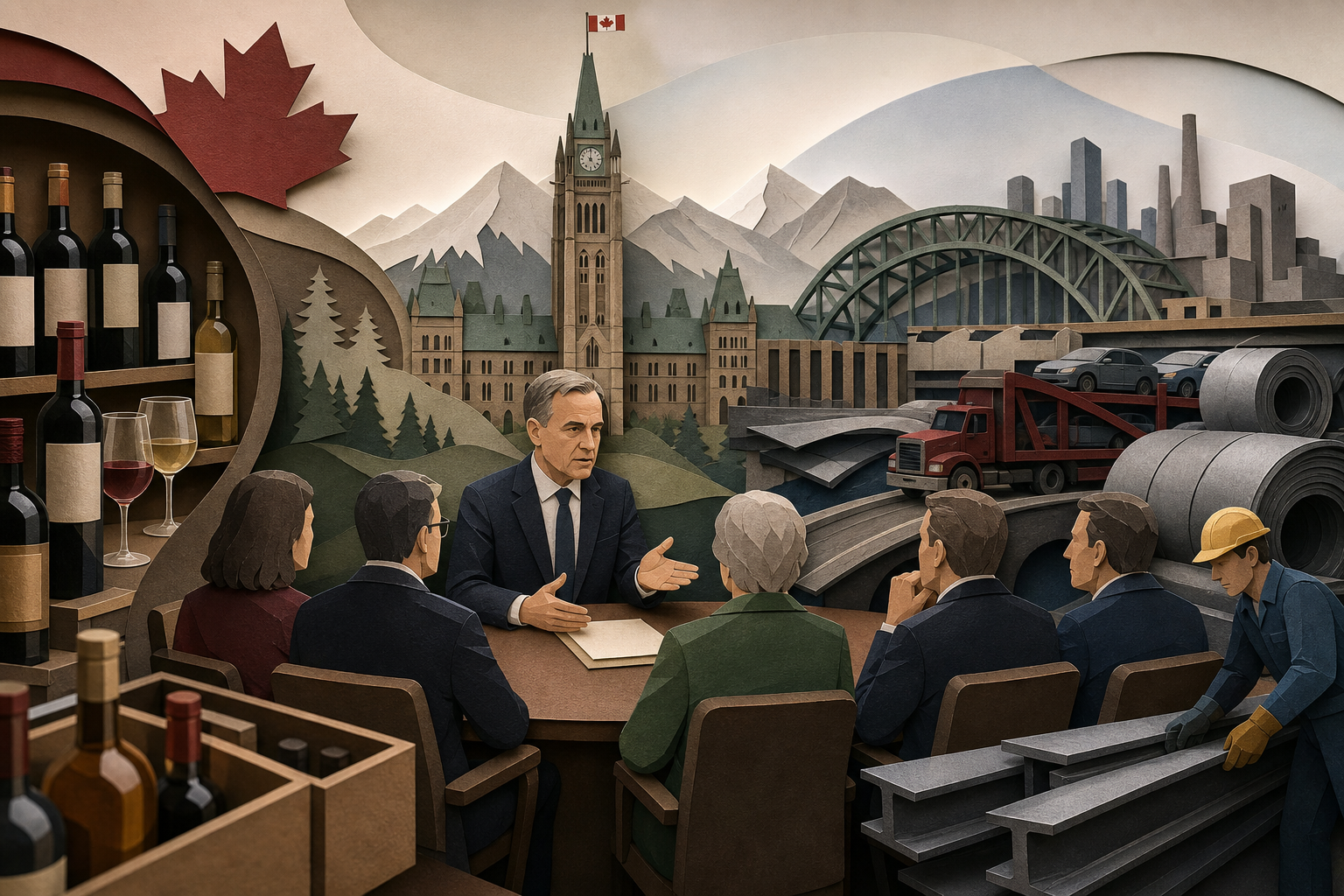

Prime Minister Mark Carney asked Canada's provincial premiers during a virtual briefing on Wednesday, August 19, 2026, to remove restrictions on American wine, beer, and spirits from provincial liquor boards. The request came as negotiators from both countries finalized language on a bilateral trade deal designed to prevent the Trump administration from imposing a 50% tariff on Canadian exports.
The trade-off is straightforward. Canada lifts provincial barriers that have frustrated U.S. alcohol producers for decades. In return, the United States backs away from Section 232 tariffs that would have hit $20 billion worth of Canadian steel, aluminum, and manufactured goods. The federal government in Ottawa cannot force provinces to change liquor policy, which is why Carney, acting as special envoy, went directly to the premiers with what amounts to a national economic ask disguised as a provincial regulatory tweak.
Why Alcohol Became the Lever
Interprovincial trade barriers in Canada, particularly around alcohol, have been a persistent irritant in North American trade frameworks since NAFTA. The U.S. Trade Representative has flagged discriminatory liquor board policies in formal reports going back to the mid-1990s. Provincial liquor monopolies control shelf placement, pricing, and distribution, often giving preferential treatment to local producers. A California winery or Oregon brewery has no direct route to market. They rely on provincial boards that frequently deprioritize foreign product.
When the Trump administration threatened universal baseline tariffs in early 2026, the alcohol file became useful leverage because it required no congressional approval and cost the federal government nothing. Lifting liquor restrictions is a concession Canada can deliver quickly if the provinces cooperate, which makes it an efficient bargaining chip in a negotiation where timing mattered more than scale.
What Canada Kept Off the Table
The agreement leaves supply management untouched. Dairy, poultry, and eggs remain protected by the quota system that has been a red line in every trade negotiation Canada has entered since the 1970s. Agriculture lobbies in the U.S. have pushed for quota elimination repeatedly. They did not get it here. The alcohol concession appears to have satisfied the reciprocity framing the Trump administration uses publicly without requiring Canada to dismantle the structural protections that underpin rural economies in Ontario, Quebec, and British Columbia.
Energy exports also stayed out of the deal, despite representing the largest single component of Canada-U.S. trade. In 2025, 73% of Canadian exports were destined for the United States, though that share has been declining in 2026, and energy, crude oil, natural gas, electricity, makes up the bulk of that flow. The tariff threat covered goods broadly, but exempting energy was understood by both sides as a baseline condition. Disrupting energy trade would have caused immediate price spikes in the U.S. Midwest and Northeast, a politically untenable outcome in an election cycle.
The Provincial Calculation
Premiers now face a choice between protecting local craft breweries and wineries from U.S. competition, or facilitating a federal deal that prevents auto plants, steel mills, and aerospace manufacturers from absorbing tariff costs that would ripple through the broader economy. The numbers are lopsided. Canada's retail alcohol market is worth $27.3 billion in 2026. Daily two-way trade with the United States runs at $3.6 billion CAD. A prolonged tariff fight would have damaged industries that employ hundreds of thousands more workers than the provincial liquor sectors combined.
Some trade analysts worry this sets a precedent, that the U.S. can extract regulatory concessions by threatening tariffs on unrelated sectors. The counter-argument is that Canada traded a low-cost provincial irritant for stability in industries where supply chains are measured in decades, not product cycles. Whether that calculus holds depends on how the provinces respond to Carney's letter, and whether the U.S. accepts gradual implementation or demands immediate shelf access.
Sources
Read Next
Wells Fargo Says Rising Bond Yields Should Force You to Rethink Your Stock Portfolio
At the Top Tax Bracket, Every Dollar of Rental Interest Returns 53 Cents: Why the Smith Manoeuvre™ Is a High-Income Play
China's Treasury retreat to record lows rewrites the rules for bond investors
GIC Rates Below 4.2% Flip the Smith Manoeuvre™ Math From Marginal to Compelling