Turn your mortgage into a wealth-building tool. Smith Manoeuvre strategies, tax-smart planning, and honest math from two Canadian mortgage strategists.
Canada Is Headed for More Consumer Insolvencies Than 2009, and the Drivers Are Different This Time
In 2009, people lost their jobs. In 2026, they're keeping them but still can't pay their bills.
That structural difference explains why 37,239 Canadians filed for insolvency in the second quarter of this year despite an unemployment rate that remains historically low. The raw numbers have returned to levels last seen during the Global Financial Crisis, but the mechanism pushing households over the edge has shifted entirely. Job loss drove the 2009 spike. Today, it's the cost of servicing debt that already exists.
The math is straightforward. A homeowner who locked in a five-year fixed mortgage at 1.79% in early 2021 is now renewing at somewhere between 4.5% and 5.8%, depending on their credit profile and the lender. On a $400,000 mortgage with 23 years remaining, that difference translates to an additional $650 to $900 per month in payments. For a household already carrying $18,000 in credit card balances and a car loan, that extra monthly draw eliminates discretionary income entirely. The income didn't disappear. The room to maneuver did.
The Proposal Preference
Roughly 78% of the Q2 filings were consumer proposals rather than outright bankruptcies. A consumer proposal is a negotiated agreement to repay a portion of what's owed, typically 30 to 50 cents on the dollar, over a period of up to five years. It allows the debtor to keep assets like a home or vehicle, which bankruptcy often does not.
The dominance of proposals signals a shift in how Canadians frame insolvency. Bankruptcy carries the weight of total failure. A proposal reads more like a structured negotiation, closer to what a corporation might pursue in a restructuring. The mechanism itself hasn't changed, but the perception and willingness to use it have. That cultural shift has accelerated over the last decade, particularly as non-profit credit counselling agencies and licensed insolvency trustees have reframed proposals as a financial reset rather than a capitulation.
The Small Business Spillover
Business insolvencies rose more than 40% in several monthly reports through the first half of 2024, and that trend has continued into 2026. Many Canadian entrepreneurs fund operations through personal lines of credit or credit cards when business credit is unavailable or exhausted. When the business fails, the personal liability remains. The Office of the Superintendent of Bankruptcy has noted that spikes in business filings often precede corresponding increases in consumer filings by six to twelve months. The small business owner who spent eighteen months trying to save the company with personal credit eventually becomes a personal insolvency statistic.
The Lag That Hasn't Caught Up
The Bank of Canada began cutting rates in mid-2024, and the overnight rate has dropped by 175 basis points since then. Relief from those cuts, however, operates on a lag. Households with variable-rate mortgages see immediate changes in their payments, but the majority of Canadian mortgages are fixed-rate with terms of three to five years. Relief arrives at renewal, not at the policy announcement.
For households already in financial distress, that lag means the insolvency filing today reflects decisions and shocks from twelve months ago, when rates were still climbing and inflation in non-discretionary categories like groceries and rent was eating into emergency savings. The Q2 numbers are not forward-looking. They are backward-looking, a rearview reflection of conditions that peaked in late 2023 and early 2024.
Statistics Canada reported that Canadian households owed $1.76 in credit market debt for every dollar of disposable income in early 2026. The ratio has been relatively stable, but stability at that level means there is no buffer. A small increase in debt-servicing costs or a small reduction in income pushes the household into negative cash flow immediately.
Insolvency filings are expected to remain elevated through late 2025 and into early 2026, even as interest rates continue to fall. The structure of the problem, debt service overwhelming cash flow in an otherwise stable employment environment, means the fixes take longer to work through the system than they did when the problem was unemployment.


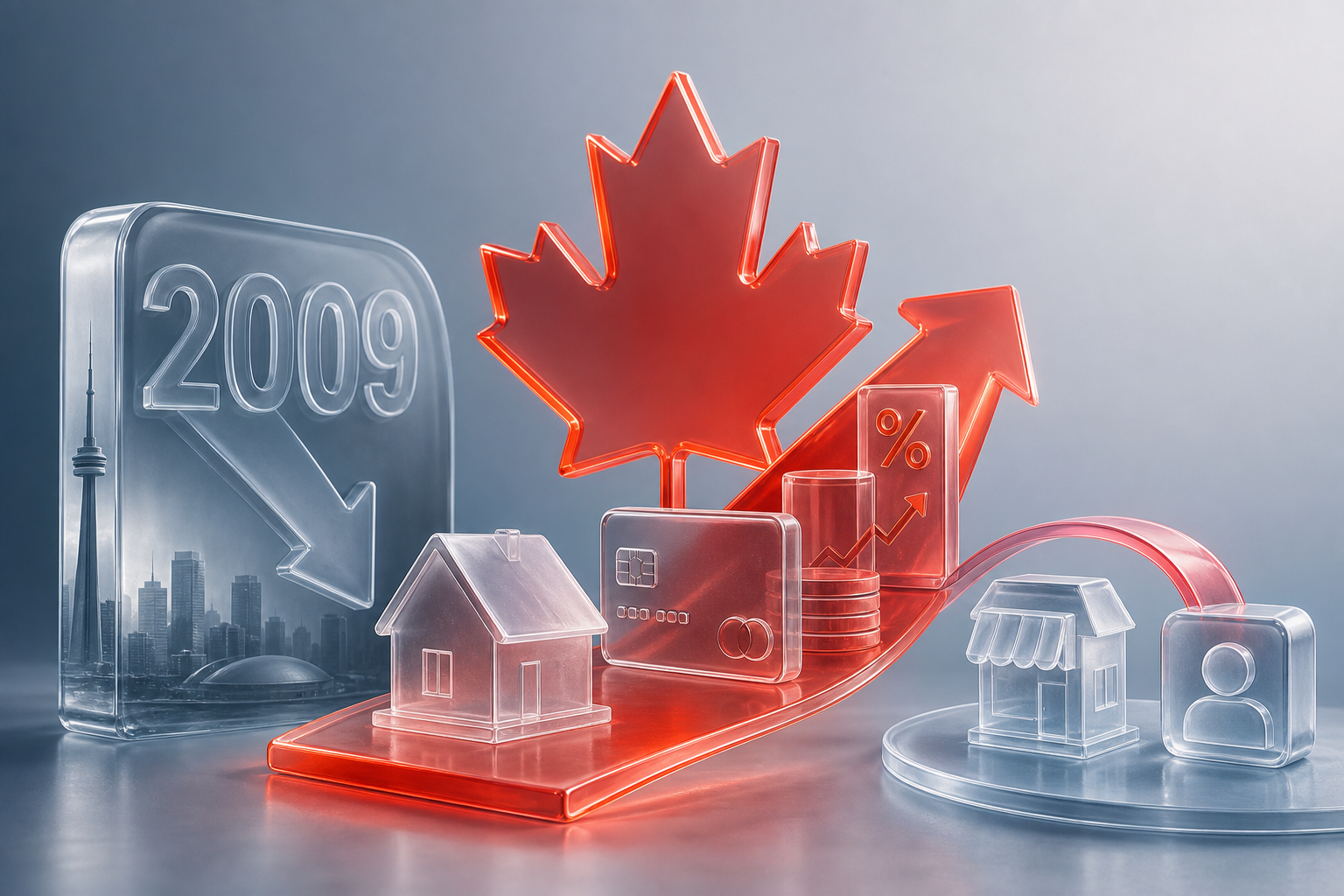

In 2009, people lost their jobs. In 2026, they're keeping them but still can't pay their bills.
That structural difference explains why 37,239 Canadians filed for insolvency in the second quarter of this year despite an unemployment rate that remains historically low. The raw numbers have returned to levels last seen during the Global Financial Crisis, but the mechanism pushing households over the edge has shifted entirely. Job loss drove the 2009 spike. Today, it's the cost of servicing debt that already exists.
The math is straightforward. A homeowner who locked in a five-year fixed mortgage at 1.79% in early 2021 is now renewing at somewhere between 4.5% and 5.8%, depending on their credit profile and the lender. On a $400,000 mortgage with 23 years remaining, that difference translates to an additional $650 to $900 per month in payments. For a household already carrying $18,000 in credit card balances and a car loan, that extra monthly draw eliminates discretionary income entirely. The income didn't disappear. The room to maneuver did.
The Proposal Preference
Roughly 78% of the Q2 filings were consumer proposals rather than outright bankruptcies. A consumer proposal is a negotiated agreement to repay a portion of what's owed, typically 30 to 50 cents on the dollar, over a period of up to five years. It allows the debtor to keep assets like a home or vehicle, which bankruptcy often does not.
The dominance of proposals signals a shift in how Canadians frame insolvency. Bankruptcy carries the weight of total failure. A proposal reads more like a structured negotiation, closer to what a corporation might pursue in a restructuring. The mechanism itself hasn't changed, but the perception and willingness to use it have. That cultural shift has accelerated over the last decade, particularly as non-profit credit counselling agencies and licensed insolvency trustees have reframed proposals as a financial reset rather than a capitulation.
The Small Business Spillover
Business insolvencies rose more than 40% in several monthly reports through the first half of 2024, and that trend has continued into 2026. Many Canadian entrepreneurs fund operations through personal lines of credit or credit cards when business credit is unavailable or exhausted. When the business fails, the personal liability remains. The Office of the Superintendent of Bankruptcy has noted that spikes in business filings often precede corresponding increases in consumer filings by six to twelve months. The small business owner who spent eighteen months trying to save the company with personal credit eventually becomes a personal insolvency statistic.
The Lag That Hasn't Caught Up
The Bank of Canada began cutting rates in mid-2024, and the overnight rate has dropped by 175 basis points since then. Relief from those cuts, however, operates on a lag. Households with variable-rate mortgages see immediate changes in their payments, but the majority of Canadian mortgages are fixed-rate with terms of three to five years. Relief arrives at renewal, not at the policy announcement.
For households already in financial distress, that lag means the insolvency filing today reflects decisions and shocks from twelve months ago, when rates were still climbing and inflation in non-discretionary categories like groceries and rent was eating into emergency savings. The Q2 numbers are not forward-looking. They are backward-looking, a rearview reflection of conditions that peaked in late 2023 and early 2024.
Statistics Canada reported that Canadian households owed $1.76 in credit market debt for every dollar of disposable income in early 2026. The ratio has been relatively stable, but stability at that level means there is no buffer. A small increase in debt-servicing costs or a small reduction in income pushes the household into negative cash flow immediately.
Insolvency filings are expected to remain elevated through late 2025 and into early 2026, even as interest rates continue to fall. The structure of the problem, debt service overwhelming cash flow in an otherwise stable employment environment, means the fixes take longer to work through the system than they did when the problem was unemployment.
Read Next
Wells Fargo Says Rising Bond Yields Should Force You to Rethink Your Stock Portfolio
At the Top Tax Bracket, Every Dollar of Rental Interest Returns 53 Cents: Why the Smith Manoeuvre™ Is a High-Income Play
China's Treasury retreat to record lows rewrites the rules for bond investors
GIC Rates Below 4.2% Flip the Smith Manoeuvre™ Math From Marginal to Compelling