Turn your mortgage into a wealth-building tool. Smith Manoeuvre strategies, tax-smart planning, and honest math from two Canadian mortgage strategists.
Australia Bans AI Tracks From Charts, Forcing the Industry to Define What Actually Counts as Music
An unauthorized remix of Madonna's "Like a Prayer", built entirely from synthesized vocals and percussion that mimicked the original without her involvement, spent sixteen weeks in Australia's Top 20 before regulators finally acted. The Australian Recording Industry Association announced this month that tracks utilizing AI-generated vocals or primary instrumentation will no longer qualify for the ARIA Top 50. The decision forces the industry to draw a line it has long avoided: what percentage of a recording must be human for it to count as music?
The policy distinguishes between "AI-assisted" and "AI-generated." Auto-Tune remains permitted. So does algorithmic mastering, pitch correction, and the entire suite of digital production tools that have defined commercial pop for three decades. What's banned is the creative replacement of the artist. ARIA now requires a "predominant human element" in the lead vocal performance. If the person named on the track did not step into a booth and deliver the take, the recording cannot chart.
The enforcement problem no one wants to admit
The new rule assumes chart monitors can tell the difference. They cannot, at least not reliably. Modern AI vocal models produce frequency patterns that sit comfortably within the range of heavy studio processing. A producer who does not volunteer that a vocal was generated has no technical obligation to disclose it, and the sonic fingerprint is often indistinguishable from a highly processed human singer. ARIA's policy works only if violators self-report or rights holders file complaints. The Madonna case succeeded because the remix was viral enough to attract legal attention. A less prominent track using the same method would slip through.
The Australian royalty collection body APRA AMCOS is now advocating for "credit and consent" frameworks that would require AI developers to license the catalogs they train on. Under current law, an AI model can ingest Madonna's entire discography as training data without payment. The resulting output uses her style, her phrasing, sometimes even the timbral signature of her voice, but because the model synthesizes rather than samples, no copyright is technically breached. The composition remains protected. The recording of the composition remains protected. The voice itself, the thing that was actually stolen, has no clear legal status.
What the market already decided
Australian listeners spent four months streaming an AI Madonna without apparent concern. The track's commercial performance suggests that for a significant portion of the audience, authenticity is no longer a prerequisite for engagement. The production was tight, the vocal delivery matched the modern dance template, and the attribution to Madonna gave it cultural weight. Whether she sang it became a secondary question.
This is the wedge. Once the market tolerates one high-profile AI hit, the floodgates problem becomes structural rather than hypothetical. ARIA's ban is an attempt to preserve the charts as a record of human cultural achievement, not just popular sound. The policy draws a bright line, but it cannot enforce that line at scale. Every plugin manufacturer is now embedding generative features into standard digital audio workstations. The distance between "assisted" and "generated" will continue to narrow until the distinction becomes undetectable.
The sixteen-week run of an AI-generated track in a major market opened a path that the industry had long avoided addressing. Australia responded with a ban. The rest of the industry is watching to see whether that ban holds, or whether it simply creates a subset of officially sanctioned music that exists alongside a parallel, unregulated category of generative hits that never touch the charts but dominate the streams.


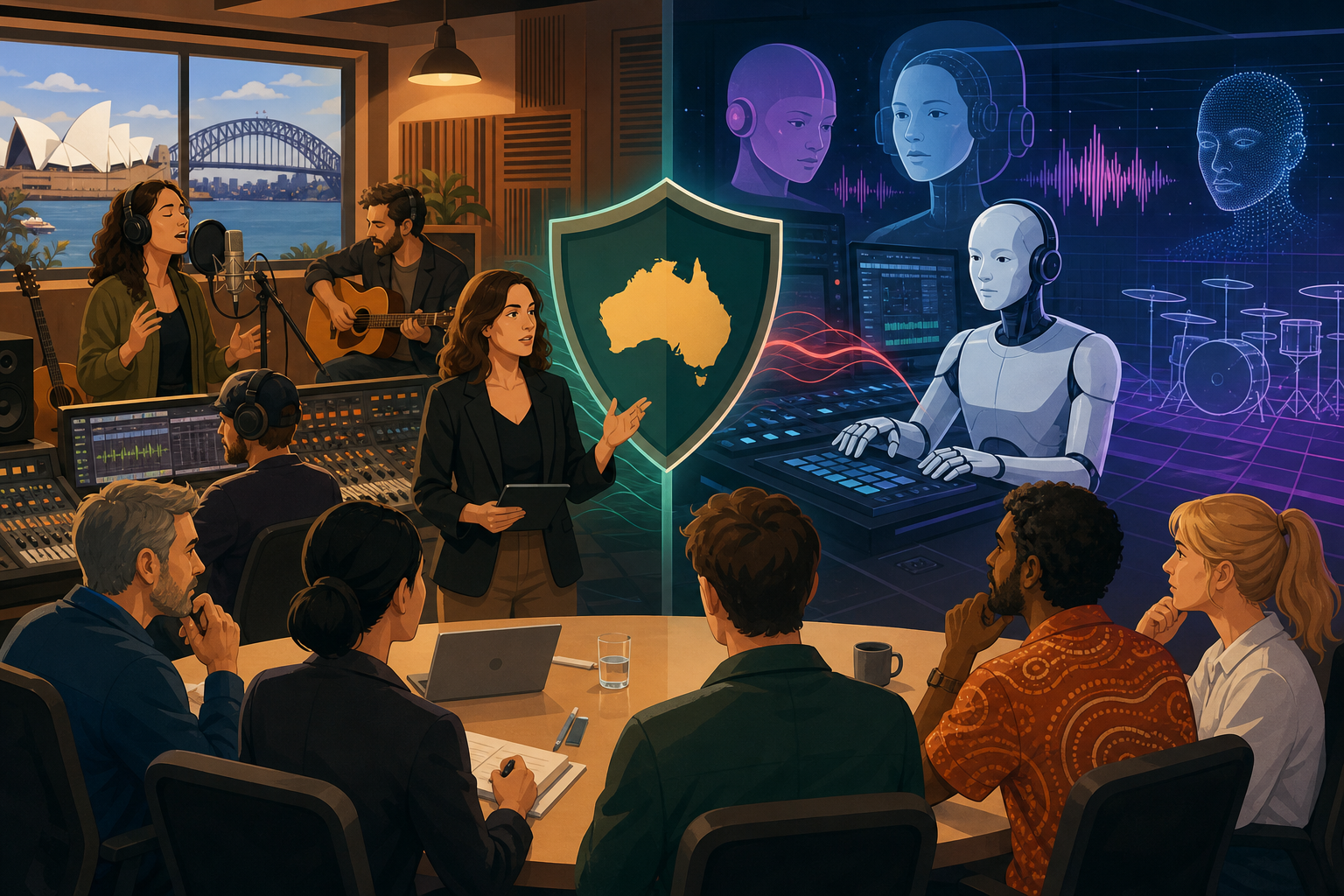

An unauthorized remix of Madonna's "Like a Prayer", built entirely from synthesized vocals and percussion that mimicked the original without her involvement, spent sixteen weeks in Australia's Top 20 before regulators finally acted. The Australian Recording Industry Association announced this month that tracks utilizing AI-generated vocals or primary instrumentation will no longer qualify for the ARIA Top 50. The decision forces the industry to draw a line it has long avoided: what percentage of a recording must be human for it to count as music?
The policy distinguishes between "AI-assisted" and "AI-generated." Auto-Tune remains permitted. So does algorithmic mastering, pitch correction, and the entire suite of digital production tools that have defined commercial pop for three decades. What's banned is the creative replacement of the artist. ARIA now requires a "predominant human element" in the lead vocal performance. If the person named on the track did not step into a booth and deliver the take, the recording cannot chart.
The enforcement problem no one wants to admit
The new rule assumes chart monitors can tell the difference. They cannot, at least not reliably. Modern AI vocal models produce frequency patterns that sit comfortably within the range of heavy studio processing. A producer who does not volunteer that a vocal was generated has no technical obligation to disclose it, and the sonic fingerprint is often indistinguishable from a highly processed human singer. ARIA's policy works only if violators self-report or rights holders file complaints. The Madonna case succeeded because the remix was viral enough to attract legal attention. A less prominent track using the same method would slip through.
The Australian royalty collection body APRA AMCOS is now advocating for "credit and consent" frameworks that would require AI developers to license the catalogs they train on. Under current law, an AI model can ingest Madonna's entire discography as training data without payment. The resulting output uses her style, her phrasing, sometimes even the timbral signature of her voice, but because the model synthesizes rather than samples, no copyright is technically breached. The composition remains protected. The recording of the composition remains protected. The voice itself, the thing that was actually stolen, has no clear legal status.
What the market already decided
Australian listeners spent four months streaming an AI Madonna without apparent concern. The track's commercial performance suggests that for a significant portion of the audience, authenticity is no longer a prerequisite for engagement. The production was tight, the vocal delivery matched the modern dance template, and the attribution to Madonna gave it cultural weight. Whether she sang it became a secondary question.
This is the wedge. Once the market tolerates one high-profile AI hit, the floodgates problem becomes structural rather than hypothetical. ARIA's ban is an attempt to preserve the charts as a record of human cultural achievement, not just popular sound. The policy draws a bright line, but it cannot enforce that line at scale. Every plugin manufacturer is now embedding generative features into standard digital audio workstations. The distance between "assisted" and "generated" will continue to narrow until the distinction becomes undetectable.
The sixteen-week run of an AI-generated track in a major market opened a path that the industry had long avoided addressing. Australia responded with a ban. The rest of the industry is watching to see whether that ban holds, or whether it simply creates a subset of officially sanctioned music that exists alongside a parallel, unregulated category of generative hits that never touch the charts but dominate the streams.
Sources
Read Next
Wells Fargo Says Rising Bond Yields Should Force You to Rethink Your Stock Portfolio
At the Top Tax Bracket, Every Dollar of Rental Interest Returns 53 Cents: Why the Smith Manoeuvre™ Is a High-Income Play
China's Treasury retreat to record lows rewrites the rules for bond investors
GIC Rates Below 4.2% Flip the Smith Manoeuvre™ Math From Marginal to Compelling