Turn your mortgage into a wealth-building tool. Smith Manoeuvre strategies, tax-smart planning, and honest math from two Canadian mortgage strategists.
A reverse mortgage lets you delay downsizing, but the cost accumulates faster than most borrowers expect
A reverse mortgage lets you delay downsizing, but the cost accumulates faster than most borrowers expect
Eleanor Chen turned 67 in February 2024 and took out a reverse mortgage on her Etobicoke semi for $87,000. The appraised value was $940,000. She planned to use the money to cover property taxes, utilities, and groceries while she waited for the market to recover from the 2023 slowdown. Her realtor had advised her that spring 2026 would be a better time to sell. The reverse mortgage, through HomeEquity Bank, carried a fixed rate of 7.39%. No monthly payments. She'd move in two years, pay it off, pocket the rest.
By August 2026, she owes $98,200. The debt grew by $11,200 in twenty-nine months. She hasn't sold yet. The market didn't recover the way the realtor expected, and moving now would mean netting less than she'd planned. If she waits another two years, the debt will be near $112,000. That's $25,000 in interest on an $87,000 loan over four years, compounding at a rate most people associate with credit cards, not home equity products.
The math most borrowers miss
Reverse mortgages in Canada typically run 2% to 3% above standard five-year fixed rates, which in 2026 puts them in the 7% to 8% range. The key difference is that interest compounds monthly without reduction. A traditional mortgage amortizes. You pay down principal every month. A reverse mortgage does the opposite. The amount owing grows every month, and because no payments are made, the interest accrues on an ever-larger base.
At 7.5%, an $80,000 reverse mortgage becomes $86,200 after one year. After five years, it's $114,500. After ten, $165,000. The rule of thumb is that the debt roughly doubles every decade. Most borrowers who take one out at 65 expecting to move at 72 hit the seven-year mark and realize the interest has consumed a meaningful portion of the equity cushion they thought they had.
HomeEquity Bank and Equitable Bank, the two dominant players in the Canadian reverse mortgage market, both offer a "no negative equity guarantee," which means the debt can never exceed the home's value at sale. That's real protection. But it doesn't mean the cost is low. It means the cost is capped at total liquidation.
When the bridge becomes permanent
The original pitch is always the same: buy time. Wait for the market. Wait for rates to drop. Wait until you're ready. The problem is that waiting has a price, and the price escalates.
A 2025 OSFI report showed that the average reverse mortgage in Canada at that time had been outstanding for 6.8 years, not the 2 to 4 years most borrowers projected at origination. The longer the loan runs, the more equity it consumes. For someone who takes out $100,000 at age 65 and doesn't sell until 78, the compounded debt often exceeds $200,000. The home that was worth $900,000 in 2026 may sell for $1.1 million in 2039, but after real estate commissions and legal fees, the net proceeds shrink fast.
The borrowers who do well with reverse mortgages are the ones who use them tactically: a three-year bridge while renovating the home for accessibility, or a short-term income supplement that gets repaid when an RRSP matures. The ones who struggle are those who treat it as a multi-decade income stream and wake up at 80 with half their equity gone.
What it actually costs to wait
Downsizing in 2026 isn't cheap. A 5% real estate commission on a $950,000 home is $47,500. Add legal fees, land transfer tax if moving within Ontario, and the cost of moving itself, and the all-in hit can reach $60,000. A reverse mortgage that lets you avoid that transaction for three years costs about $18,000 in interest on a $75,000 advance at 7.5%. On paper, waiting makes sense.
But the reverse mortgage doesn't make downsizing free. It makes it later. And later is more expensive.
Eleanor still lives in the semi. She's now considering whether to take a second advance to cover rising insurance premiums. The loan allows it. The question is whether the house, in the end, will.


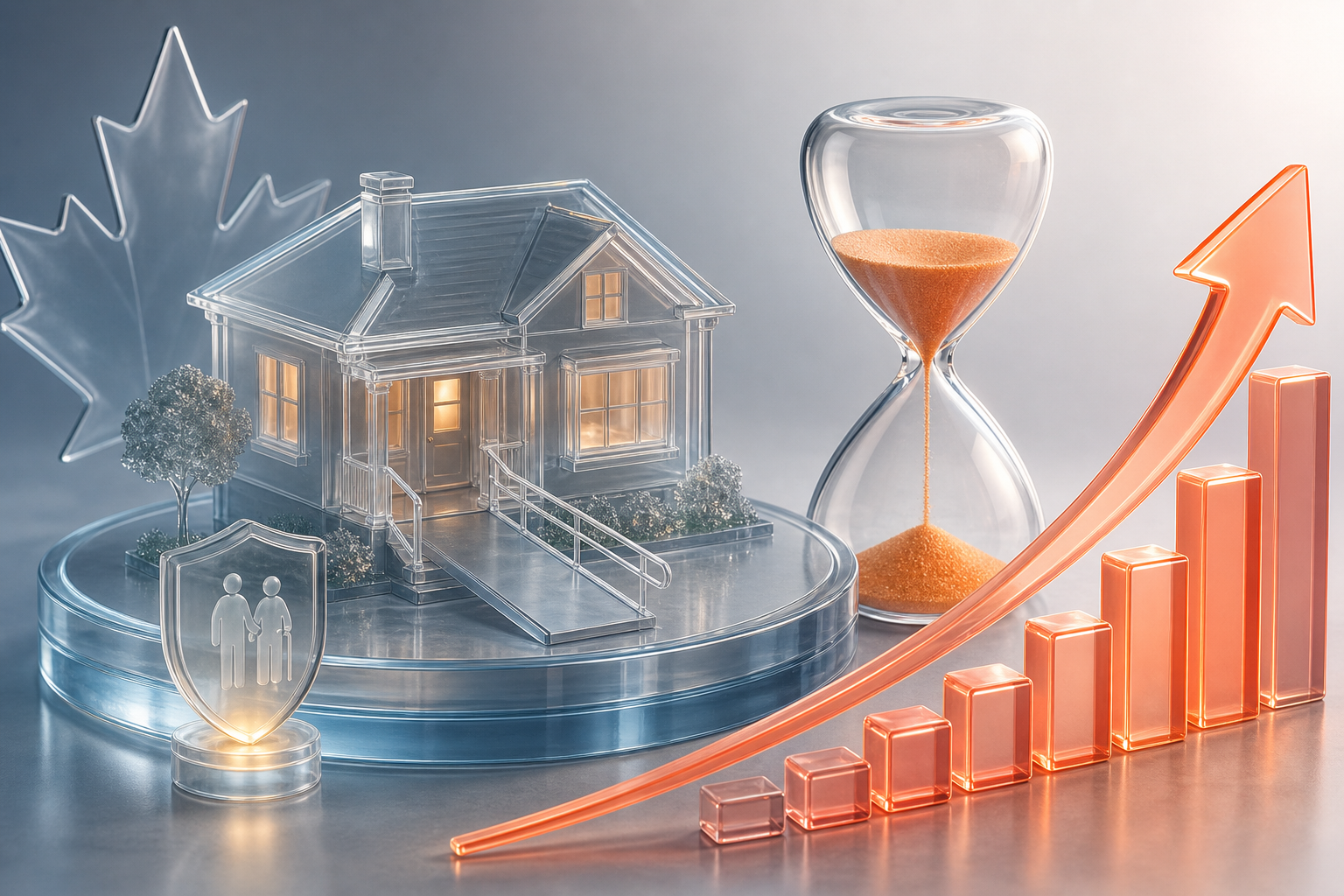

A reverse mortgage lets you delay downsizing, but the cost accumulates faster than most borrowers expect
Eleanor Chen turned 67 in February 2024 and took out a reverse mortgage on her Etobicoke semi for $87,000. The appraised value was $940,000. She planned to use the money to cover property taxes, utilities, and groceries while she waited for the market to recover from the 2023 slowdown. Her realtor had advised her that spring 2026 would be a better time to sell. The reverse mortgage, through HomeEquity Bank, carried a fixed rate of 7.39%. No monthly payments. She'd move in two years, pay it off, pocket the rest.
By August 2026, she owes $98,200. The debt grew by $11,200 in twenty-nine months. She hasn't sold yet. The market didn't recover the way the realtor expected, and moving now would mean netting less than she'd planned. If she waits another two years, the debt will be near $112,000. That's $25,000 in interest on an $87,000 loan over four years, compounding at a rate most people associate with credit cards, not home equity products.
The math most borrowers miss
Reverse mortgages in Canada typically run 2% to 3% above standard five-year fixed rates, which in 2026 puts them in the 7% to 8% range. The key difference is that interest compounds monthly without reduction. A traditional mortgage amortizes. You pay down principal every month. A reverse mortgage does the opposite. The amount owing grows every month, and because no payments are made, the interest accrues on an ever-larger base.
At 7.5%, an $80,000 reverse mortgage becomes $86,200 after one year. After five years, it's $114,500. After ten, $165,000. The rule of thumb is that the debt roughly doubles every decade. Most borrowers who take one out at 65 expecting to move at 72 hit the seven-year mark and realize the interest has consumed a meaningful portion of the equity cushion they thought they had.
HomeEquity Bank and Equitable Bank, the two dominant players in the Canadian reverse mortgage market, both offer a "no negative equity guarantee," which means the debt can never exceed the home's value at sale. That's real protection. But it doesn't mean the cost is low. It means the cost is capped at total liquidation.
When the bridge becomes permanent
The original pitch is always the same: buy time. Wait for the market. Wait for rates to drop. Wait until you're ready. The problem is that waiting has a price, and the price escalates.
A 2025 OSFI report showed that the average reverse mortgage in Canada at that time had been outstanding for 6.8 years, not the 2 to 4 years most borrowers projected at origination. The longer the loan runs, the more equity it consumes. For someone who takes out $100,000 at age 65 and doesn't sell until 78, the compounded debt often exceeds $200,000. The home that was worth $900,000 in 2026 may sell for $1.1 million in 2039, but after real estate commissions and legal fees, the net proceeds shrink fast.
The borrowers who do well with reverse mortgages are the ones who use them tactically: a three-year bridge while renovating the home for accessibility, or a short-term income supplement that gets repaid when an RRSP matures. The ones who struggle are those who treat it as a multi-decade income stream and wake up at 80 with half their equity gone.
What it actually costs to wait
Downsizing in 2026 isn't cheap. A 5% real estate commission on a $950,000 home is $47,500. Add legal fees, land transfer tax if moving within Ontario, and the cost of moving itself, and the all-in hit can reach $60,000. A reverse mortgage that lets you avoid that transaction for three years costs about $18,000 in interest on a $75,000 advance at 7.5%. On paper, waiting makes sense.
But the reverse mortgage doesn't make downsizing free. It makes it later. And later is more expensive.
Eleanor still lives in the semi. She's now considering whether to take a second advance to cover rising insurance premiums. The loan allows it. The question is whether the house, in the end, will.
Read Next
Wells Fargo Says Rising Bond Yields Should Force You to Rethink Your Stock Portfolio
At the Top Tax Bracket, Every Dollar of Rental Interest Returns 53 Cents: Why the Smith Manoeuvre™ Is a High-Income Play
China's Treasury retreat to record lows rewrites the rules for bond investors
GIC Rates Below 4.2% Flip the Smith Manoeuvre™ Math From Marginal to Compelling